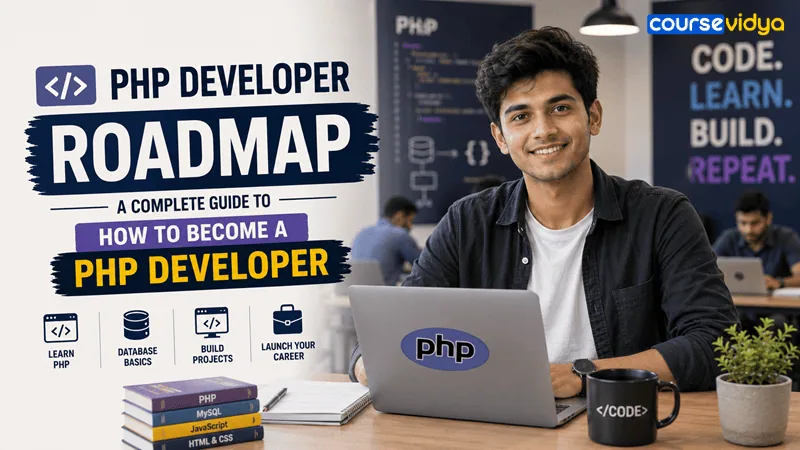
Looking for the best and advanced PHP Developer roadmap?
With thousands of companies using PHP for web development, there are still plenty of career opportunities for skilled PHP Developers.
In this guide, you’ll learn the complete PHP Developer roadmap, starting from PHP basics and databases to Laravel, Git, APIs, and real-world projects, to land your first PHP Developer job.
The Impact of AI on the PHP job market
If you are wondering how to become a PHP developer, start by understanding the current PHP job market.
In the last 5 years, the PHP job market has changed significantly. Most companies now expect PHP developers to know more than just core PHP syntax. Knowledge of frameworks like Laravel, databases, REST APIs, Git, and modern development practices is increasingly expected.
Today, for securing junior PHP Developer jobs, freshers are increasingly expected to effectively use AI coding assistants such as GitHub Copilot and ChatGPT to improve productivity while focusing on tasks that require human skills, such as designing better solutions and handling complex business requirements.
Before, common entry-level PHP job titles included Trainee PHP Developer, Junior PHP Developer, Junior Web Developer, PHP Programmer, and Assistant Web Programmer. The average salary of a fresher PHP developer in India was around ₹1.5 LPA to ₹3 LPA.
Now, common PHP job roles for freshers are Junior PHP Engineer, Junior Backend Developer (PHP/Laravel), and Associate Full-Stack Developer. Typical starting salaries for fresher PHP developers in India generally range from ₹3 LPA to ₹6 LPA, depending on the company, location, skills, and whether the role is in a service-based or product-based organization.
PHP career path mapping
In the PHP Developer roadmap, knowing the career path is an important step for freshers. The PHP career path helps you understand the future career opportunities in this field.
Entry-level: 0-2 years of experience
Job roles: Junior PHP Developer, Junior Laravel/Symfony Developer, Associate PHP Engineer, Junior Backend Developer (PHP), Trainee PHP Developer.
Mid-level: 2-5 years of experience
Job roles: PHP Developer, Backend Developer (PHP/Laravel), Laravel Developer, PHP Software Engineer, Full-Stack PHP Developer.
Senior: 5-8 years of experience
Job roles: Senior PHP Developer, Senior Backend Engineer, Technical Lead, Solution Architect, Engineering Manager (in larger organizations)
Principal / Architect / Engineering Management: 8+ years of experience
Job roles: Principal Software Engineer (PHP), Principal Software Engineer (PHP), Enterprise Backend Architect, Solutions Architect, Software Engineering Manager.
What educational qualifications are required for junior PHP Developer jobs?
A PHP Developer roadmap should provide a clear idea about the academic background needed for beginners who want to build a successful career in PHP.
Many corporate job descriptions specify minimum educational qualifications to help filter large volumes of applications for fresher PHP developer roles.
- A Bachelor’s degree in engineering, such as B.Tech/B.E. in Computer Science or Information Technology.
- A Bachelor’s degree in Computer Applications (BCA), Master of Computer Applications (MCA), or a B.Sc. in Computer Science.
- Diplomas in computer science or software engineering, along with industry-recognized training programs or tech bootcamps, may also help candidates qualify for entry-level PHP roles, particularly when supported by strong practical skills and projects.
However, not all employers require a specific academic background. Many companies, particularly startups, also consider candidates with relevant certifications, strong GitHub portfolios, practical projects, and demonstrable PHP development skills.
You can strengthen your chances of securing fresher PHP Developer jobs by earning relevant certifications, building a strong GitHub portfolio, and showcasing practical PHP projects.
Skills required for becoming a PHP Developer
The first step in learning how to become a PHP developer is to develop strong coding fundamentals and practice writing clean, efficient PHP code.
If you want to secure PHP Developer jobs for freshers without any experience, you must develop the following skills.
PHP fundamentals
The first step in a PHP Developer Roadmap is to understand the fundamentals of programming, including variables, data types, operators, control structures (loops and conditionals), functions, and problem-solving logic.
- Object-Oriented Programming (OOP)
- PHP 8.x Features
- Superglobals and Form Handling
Database management and SQL
Learning Database Management and SQL is crucial for starting a PHP Developer roadmap.
- Basics of MySQL
- PDO (PHP Data Objects) for secure database access in native PHP applications
- Database Security (SQL Injection prevention, Secure password hashing, Input validation, XSS, and CSRF awareness)
A modern PHP framework (especially Laravel or Symfony)
Writing applications using only basic PHP can become difficult and time-consuming for large projects. That is why companies use frameworks like Laravel and Symfony to build secure and efficient applications faster.
Laravel is one of the most popular PHP frameworks, and learning it is an important part of how to become a PHP Developer.
- MVC Architecture
- Eloquent ORM
- Routing and Middleware
Basic frontend integration
- HTML5 and CSS3
- JavaScript and asynchronous requests (AJAX/Fetch API)
Caching basics
- Redis or Memcached (basic understanding)
Essential PHP development tools and practices
- Git and GitHub
- Composer (Dependency management, PSR-4 autoloading, and package installation and updates)
- REST APIs (Creating RESTful APIs, Consuming third-party APIs, JSON request and response handling, API authentication basics – API keys, bearer tokens, or OAuth fundamentals)
- JSON
- Authentication and Authorization
- Debugging and Error Handling
Testing and code quality
- PHPUnit
- Unit Testing
- Feature Testing
- PHPStan or Psalm (static analysis)
- Coding standards (PSR-12)
Development environment and deployment
- Local development environments (XAMPP, Laragon, Docker)
- Linux command line basics
- Apache or Nginx basics
- Environment variables (.env)
- Basic deployment to shared hosting, VPS, or cloud platforms (such as Render or Railway)
Which is better for a PHP fresher: Classroom training vs online programs
A strong foundation in PHP syntax, object-oriented programming, and error handling is essential for every aspiring PHP developer. That is why enrolling in a structured training or certification program can help you build a strong foundation and begin your PHP Developer roadmap.
The following table highlights the key differences between classroom PHP training and online certification programs.
| Feature | Classroom certification | Online certification |
|---|---|---|
| Schedule | Rigid, fixed timetable | Very flexible |
| Location | Physical campus | Online |
| Interaction | Face-to-face | Live video classes, discussion communities, Slack/Discord, video conferencing |
| Cost | Higher | Often more affordable |
| Accountability | High | Self-driven |
| Practical work | Instructor-guided coding sessions and lab practice | Virtual coding environments, local development setups, and project-based learning |
Choose a training or certification program that best matches your learning style, schedule, budget, and career goals.
Find the best PHP training institutes nearby
Best online PHP certifications for freshers
Freshers who want to become PHP developers can strengthen their profiles by earning relevant certifications alongside building practical projects and hands-on experience.
PHP Certification Course – W3Schools
Cost: Paid
PHP Certification Course by W3Schools is a beginner-friendly certification that assesses fundamental PHP concepts, including syntax, variables, forms, sessions, cookies, and database interaction. Learners can prepare using the free tutorials, interactive examples, exercises, and quizzes available on the W3Schools website.
Zend Certified PHP Engineer (Perforce)
Cost: Paid
This Zend Certified PHP Engineer (Perforce) certification is one of the most recognized professional PHP certifications. It evaluates core language syntax, arrays, data types, object-oriented programming (OOP), web security (SQL injection/XSS), and more. Earning this certification can be a valuable addition to your PHP Developer roadmap for beginners.
Certification for Laravel – Certificates.dev
Cost: Paid
If you want to validate your Laravel development knowledge, the Certification for Laravel offered by Certificates.dev is an option to consider. This certification assesses standard web application building blocks, including routing, Eloquent ORM (database management), controllers, Blade templating, and more. You can find exam details, preparation guides, and registration information on the Certificates.dev Laravel Certification website.
Remember, hiring managers place more weight on practical projects, GitHub portfolios, and Laravel experience than on PHP certifications. Certifications can strengthen a profile, but are generally not a substitute for hands-on development experience.
PHP projects for beginners
Learning PHP concepts and building real-world projects are essential steps in understanding how to become a PHP developer as a fresher. Having projects shows hiring managers that you can actually deploy clean, working code and structure a relational database.
Consider building the following PHP projects for beginners.
- E-Commerce RESTful API: Build a backend application handling product catalogs, shopping cart logic, and simulated checkout states using Laravel’s Eloquent ORM.
- Custom Content Management System (CMS): Create a dashboard that includes user authentication, session-managed access controls, and strict PDO prepared statements to ensure secure database interactions and form validation.
- Automated Third-Party Data Aggregator: Write a system that queries public external APIs, such as weather or financial data APIs, using Laravel’s HTTP Client or Guzzle.
- Task Management System: Build a web application that allows users to create, update, organize, and track tasks with features like user authentication, CRUD operations, task status, deadlines, and role-based access control using Laravel.
Once you build these PHP projects for beginners, you can upload your code repositories to GitHub or GitLab to showcase your work to recruiters and employers and deploy live applications using affordable cloud platforms like Render or Railway.
How to become a Java developer: Java classroom training vs online course: Java developer roadmap
Career opportunities for PHP freshers
To excel as a PHP developer, you must learn about the job roles you should target and what the PHP developer fresher’s salary is for those job roles.
| Target job title | Primary focus | Average entry-level salary in India |
|---|---|---|
| Junior PHP Developer | Vanilla PHP script maintenance, basic CRUD, SQL database support. | ₹2.0L – ₹3.5L |
| Junior Laravel Developer / Backend Developer (PHP) | MVC architecture, modern REST APIs, and Object-Oriented Programming (OOP). | ₹3.5L – ₹6.0L |
| Associate Full-Stack Developer | PHP backend integrated with frontend technologies such as React, Vue.js, and Tailwind CSS. | ₹4.0L – ₹6.5L |
| WordPress / CMS Developer | Custom theme styling, plugin modifications, and database configuration. | ₹1.8L – ₹3.0L |
Internships are one of the most effective ways for beginners to gain practical experience on their PHP Developer roadmap. You can use Wellfound (formerly AngelList), Internshala, and LinkedIn to find PHP internships to gather experience before you commit to full-time employment.
Networking and referrals tips for PHP freshers
If you are asking how to get a job in PHP without experience, networking can significantly improve your chances of landing a Junior PHP Developer role. Start by connecting with mid-level PHP and Laravel developers on LinkedIn and asking for brief feedback on your GitHub portfolio projects.
Additionally, share your daily coding activities and projects on LinkedIn. When a PHP professional sees your knowledge and hands-on skills, they may be more willing to refer you when a suitable internal opportunity becomes available.
PHP freshers’ strategy for resume and interview
Building a strong resume is part of learning how to get a job in PHP without experience. Follow the tips below:
- Keep your resume to a single page.
- Include a link to your GitHub right at the top.
- List your specific framework stack, such as Laravel or Symfony.
- Highlight two key projects by detailing the architecture, the database structure used, and the problem your code solved.
- Be prepared to explain your Git workflow, commit history, and the design decisions behind your projects.
Start by practicing PHP interview questions for freshers and expect questions on syntax, debugging, code review, or logical problem-solving. Always explain your thought process out loud while coding.
PHP roadmap: A 90-day learning plan
- Weeks 1–2: PHP fundamentals
- Weeks 3–4: OOP and MySQL
- Weeks 5–6: Laravel basics
- Weeks 7–8: Build two projects
- Weeks 9–10: Git, Composer, REST APIs
- Weeks 11–12: Deploy projects, prepare resume, apply for internships
Conclusion
Becoming a successful PHP developer is not about learning everything. It is about progressing along a structured, planned PHP Developer roadmap to become job-ready. The PHP industry continues to offer excellent career opportunities for freshers who have strong technical knowledge and hands-on experience. Start your journey with this PHP Developer roadmap for beginners by building a strong foundation, gaining real-world experience through projects, staying up to date with industry trends, and using AI-powered development tools.
To explore high-quality PHP training institutes, visit CourseVidya.com for a location-based search. Find the best PHP training institutes near you with a single click, with prices, reviews, and offered facilities. Visit CourseVidya.com, India’s own course search engine.