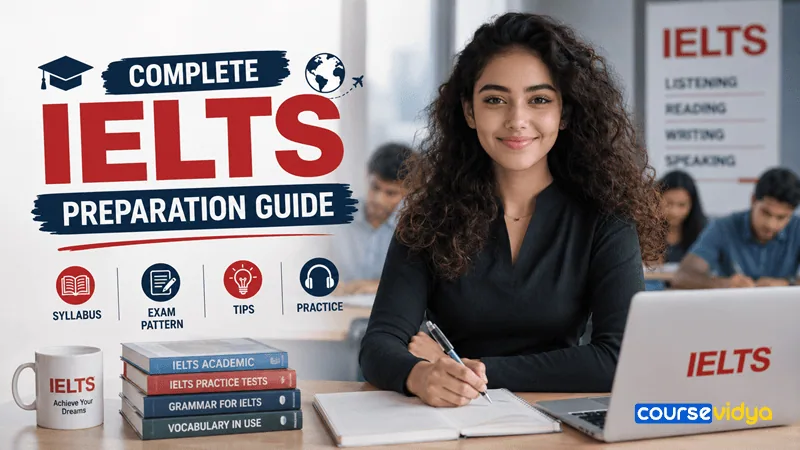
A successful IELTS preparation journey starts with knowing the exam inside out.
Preparing for IELTS requires more than improving English skills; it requires understanding the syllabus, exam pattern, question types, and scoring system.
This month-wise IELTS preparation guide will help you through each stage of your journey, from building core skills to achieving exam readiness.
IELTS exam pattern
Before starting your IELTS preparation, understand how the IELTS exam is structured. Understanding the IELTS exam pattern is the first step to learning how to prepare for IELTS.
The Listening, Reading, and Writing exams are taken one after another on the same day, with no breaks. The Speaking test may take place on the same day as, or within a few days before or after, the Listening, Reading, and Writing tests.
| Module | Duration | Structure | Test focus |
|---|---|---|---|
| Listening | Approximately 30 minutes (plus 10 minutes to transfer answers in paper-based IELTS or 2 minutes to review answers in computer-delivered IELTS) | 4 audio recordings (40 questions total) | Understanding everyday conversations, monologues, and academic discussions in global accents. |
| Reading | 60 minutes | 3 sections comprising long passages (Academic) or multiple shorter texts (General Training), with 40 questions in total. | Skimming for main ideas, scanning for details, identifying key information, and understanding ideas, opinions, and arguments. |
| Writing | 60 minutes | 2 distinct tasks (Task 1 and Task 2) | Writing data summaries or letters (depending on the module) and producing a structured academic or opinion-based essay. |
| Speaking | 11–14 minutes | 3 interactive parts | Fluency and coherence, pronunciation, vocabulary, grammatical range and accuracy, and the ability to discuss familiar and abstract topics. |
Choosing the right path: Academic vs General Training
The IELTS exam is available in two versions:
- IELTS Academic – For higher education and professional registration.
- IELTS General Training – For work, training, secondary education, and migration.
| Test Component | IELTS Academic | IELTS General Training |
|---|---|---|
| Target audience | Individuals applying for higher education or professional registration in English-speaking countries. | Individuals applying for work, training programs, secondary education, or migration, including permanent residency in English-speaking countries. |
| Reading section | 3 long, complex passages sourced from books, journals, magazines, and newspapers. | A mix of short, everyday texts (notices, company manuals, advertisements) and one long general text. |
| Writing Task 1 | Analyze and describe visual data from a chart, graph, table, or process diagram in a minimum of 150 words. | Write a formal, semi-formal, or informal letter responding to a prompt in a minimum of 150 words. |
| Writing Task 2 | A formal essay responding to a point of view, argument, or problem in a minimum of 250 words. | A formal essay on a general interest issue that may require expressing an opinion, discussing viewpoints, solving a problem, or evaluating advantages and disadvantages, in a minimum of 250 words. |
How to prepare for RRB ALP: Beginners’ guide on how to crack RRB ALP with syllabus and exam pattern
IELTS syllabus
After you have gone through the IELTS exam pattern, you need to understand the syllabus in detail. Understanding the IELTS syllabus helps you learn which question types appear in each section and how the test is organized.
While the topics vary from one test to another, the question types, context types, and overall test structure remain consistent.
IELTS syllabus for the Listening module
The Listening test is identical for both Academic and General Training candidates.
| Test part | Audio context type | Syllabus focus and skills tested | Common question types |
|---|---|---|---|
| Part 1 | Social Conversation (2 speakers) | Extracting explicit everyday facts (e.g., booking a hotel room, confirming names/numbers). | Form completion Note completion Short-answer questions |
| Part 2 | Social Monologue (1 speaker) | Navigating spatial language and instructional details (e.g., a local radio broadcast or a guided tour introduction). | Map/Plan labeling Diagram labeling Multiple choice |
| Part 3 | Academic Discussion (2–4 speakers) | Following complex academic arguments, identifying who said what, and spotting agreement/disagreement. | Matching features Multiple choice Sentence completion |
| Part 4 | Academic Lecture (1 speaker) | Understanding extended university-style lectures and identifying main ideas, supporting details, opinions, and speaker attitudes. | Flowchart completion Summary completion Table completion |
IELTS Listening question types
The IELTS Listening test includes different question formats across the four parts. While the exact combination varies from test to test, common question types include:
- Form completion
- Note completion
- Sentence completion
- Table completion
- Summary completion
- Flowchart completion
- Diagram labeling
- Map/Plan labeling
- Matching (including matching features)
- Multiple-choice questions
- Short-answer questions
- Classification
IELTS syllabus for the Reading module
The Reading module has two versions. While many question types are similar, the text styles and reading purposes differ significantly between Academic and General Training.
| Test version | Text sources and structure | Primary skills tested | Essential question types |
|---|---|---|---|
| Academic Reading | 3 long passages adapted from authentic sources such as books, journals, magazines, and newspapers. Texts may be descriptive, factual, analytical, or argumentative. | Skimming for the general gist Scanning for specific details and information Identifying the writer’s opinions, attitudes, purpose, and implied meanings | True / False / Not Given Yes / No / Not Given Matching Information Matching Paragraph Headings Matching Features Matching Sentence Endings Multiple Choice Sentence Completion Summary Completion Note Completion Table Completion Flowchart Completion Diagram Labeling Short-answer Questions |
| General Training Reading | 3 sections containing everyday social texts, workplace-related texts, and one longer general-interest passage. Sources may include notices, advertisements, workplace documents, and informational materials. | Understanding everyday and workplace information in an English-speaking environment. Locating specific details in practical and workplace-related texts | True / False / Not Given Yes / No / Not Given Matching Information Matching Paragraph Headings Matching Features Matching Sentence Endings Multiple Choice Sentence Completion Summary Completion Note Completion Table Completion Flowchart Completion Diagram Labeling Short-answer Questions |
NOTE: The exact combination of question types varies between test versions and individual test papers.
IELTS syllabus for the Writing module
The Writing module assesses your ability to communicate ideas clearly, organize information effectively, use appropriate vocabulary, and demonstrate grammatical accuracy. Examiners assess your writing using four criteria:
- Task Achievement (Task 1) / Task Response (Task 2)
- Coherence & Cohesion
- Lexical Resource
- Grammatical Range & Accuracy
| Module | Version | Prompt requirements | Syllabus focus |
|---|---|---|---|
| Task 1 (20 mins) | Academic | Summarize and report visual information from charts, graphs, tables, maps, or process diagrams (minimum 150 words). | Identifying and summarizing key features, grouping related trends, and making relevant comparisons. |
| General Training | Write a letter responding to a given situation in a formal, semi-formal, or informal tone (Min. 150 words). | Choosing the correct situational tone, formatting openings/closings, and answering all bullet prompts. | |
| Task 2 (40 mins) | Both Versions | Write a formal essay responding to a question, argument, opinion, problem, or topic (minimum 250 words). | Developing clear arguments, organizing ideas logically, using cohesive devices effectively, and demonstrating a wide range of vocabulary. |
IELTS syllabus for the Speaking module
The IELTS Speaking test is a live interview with a certified examiner, conducted either face-to-face or via video call where available.
- Part 1 – Introduction and Interview (4-5 minutes): You will answer short questions about yourself, your hometown, current studies or career, and simple interests (such as food, habits, or music).
- Part 2 – Individual Long Turn / Cue Card (3–4 minutes): The examiner will provide a cue card with a topic and points to cover. You will have 1 minute to prepare and make notes, and you must speak continuously for 1–2 minutes.
- Part 3 – Two-Way Discussion (4-5 minutes): The examiner asks broader questions related to the Part 2 theme, requiring you to discuss opinions, justify ideas, compare viewpoints, and explore more abstract issues.
Find the best IELTS coaching institutes nearby
How to prepare for IELTS: A month-wise IELTS preparation guide
If you want to learn how to prepare for IELTS at home, you need a monthly preparation plan. A month-wise IELTS preparation guide is better because it gives your study plan a clear structure and helps you improve step by step.
Month 1 of IELTS preparation: Taking a diagnostic test and building core skills
Before you start your IELTS preparation, take a complete, timed practice test from the Official Cambridge IELTS practice books or another official IELTS practice source. Avoid studying beforehand so the diagnostic test reflects your current level. You will aim to find your baseline score and note down your weakest module.
Week 1-3: Developing skills
After taking the diagnostic test, your 1st three weeks of IELTS preparation will involve developing two reading skills: Skimming and Scanning.
- Skimming: Quickly reading to understand the main idea.
- Scanning: Looking for specific information like names, dates, or keywords.
Also, focus on your listening skills by learning to identify distractors, especially when speakers answer, and then correct or change them.
For example: “Let’s meet at 4 PM… actually, I have an appointment, so let’s make it 5 PM.”
Week 4: Basic writing and speaking skills
To learn how to crack IELTS on the first attempt, you should focus on your writing skills.
In the 4th week of your IELTS preparation, you will focus on structuring paragraphs and using linking words such as furthermore, however, and consequently in a natural way.
Additionally, focus on improving speaking skills by speaking continuously for 2 minutes on simple everyday topics.
Month 2 of IELTS preparation: Strategy building and intensive practice
Beginners looking for how to prepare for IELTS at home should focus on taking mock tests to improve their accuracy and speed.
After 1 month of IELTS preparation, you will start solving IELTS practice tests. Target solving 2-3 sectional IELTS mock tests every week, followed by analyzing your mistakes.
Week 5-6: Strengthening reading and listening skills
In these two weeks, you will start practice under strict timed conditions. Consider the following IELTS preparation tips:
- Aim to complete one Reading passage under timed conditions each day (about 20 minutes).
- Aim to complete one Listening practice test each day and carefully review every mistake.
Analyze your mistakes to improve your IELTS preparation strategy instead of repeating the same errors.
Week 7-8: Improve writing and speaking
Academic: Practice identifying key trends, comparisons, and significant features in charts, graphs, tables, maps, and process diagrams, completing each task within 20 minutes.
General Training: Practice writing formal, semi-formal, and informal letters, ensuring you respond to all bullet points and use an appropriate tone within 20 minutes.
Make sure you complete each task within 20 minutes.
For writing Task 2, you will write two essays weekly. To learn how to crack IELTS on the first attempt, you must ensure clear paragraphs and explain your ideas.
If you plan to take IELTS on Computer, practice typing your Writing Task 1 and Task 2 responses within the official time limits. Also, familiarize yourself with on-screen tools such as highlighting text, scrolling through passages, and navigating between questions.
For speaking practice, record yourself answering Part 2 cue card topics. You will review your recordings to reduce long pauses and repeated filler words (e.g., um, ah) and improve pronunciation.
Month 3 of IELTS preparation: Taking full-length IELTS mock tests
Taking full-length IELTS mock tests will help you to prepare for the real IELTS exam.
Week 9-10: Simulating exact exam conditions
To learn how to crack IELTS on the first attempt, you should take full-length IELTS practice tests twice a week. Make sure you complete the Listening, Reading, and Writing sections together without breaks, just like the real exam.
Take your full-length mock tests in the same format (computer-delivered or paper-based) as your actual IELTS exam whenever possible.
Week 11: Strengthening your weak areas
Reviewing error logs from the previous month is an essential part of learning how to prepare for IELTS at home.
In week 11, start by practicing only the question types where you still lose marks. You must also consider the following IELTS preparation tips to improve your score.
- Get your Writing tasks reviewed by a teacher, expert, or reliable evaluation tool.
- Focus on correcting repeated grammar mistakes and improving your writing structure.
Week 12: Final revision
The week before the IELTS exam, only do light revision. You must review IELTS vocabulary words, essay structures, and speaking frameworks.
Additionally, review the mistakes you made during IELTS practice tests and go over the topics.
Exam Tip: Some IELTS test centers offer One Skill Retake (OSR), allowing eligible candidates to retake one test module instead of the entire exam. Availability varies by country, test provider, test center, and test format, so check with your chosen IELTS provider before booking.
Common IELTS mistakes
- Not reading instructions carefully
- Poor time management
- Copying words incorrectly in Listening
- Spending too long on one Reading question
- Memorizing Speaking answers
- Writing fewer than the minimum word count
- Ignoring Task 2 requirements
Best books for IELTS
- Official Cambridge Guide to IELTS
- Cambridge IELTS series
- Official IELTS Practice Materials
- Grammar and Vocabulary books
- Collins IELTS series
Best online resources for IELTS preparation
- Official IELTS website
- British Council IELTS preparation
- IDP IELTS preparation
- Cambridge English IELTS preparation
Common IELTS band score requirements
IELTS does not have an official pass fail score or a universal cutoff mark. Every test taker receives an Overall IELTS Band Score and individual band scores for Listening, Reading, Writing, and Speaking. The required band score depends on the university, employer, professional body, or immigration authority you are applying to.
| Purpose | Typical Overall IELTS Band Score* |
|---|---|
| Diploma/College | 5.5–6.0 |
| Undergraduate admission | 6.0–6.5 |
| Postgraduate admission | 6.5–7.0 |
| Professional registration | 7.0–8.0 (varies by profession) |
| Immigration | Varies by country and visa category |
*Typical IELTS band score requirements vary by institution, profession, country, and visa category. Always verify the latest IELTS band score requirements with the relevant university, employer, professional body, or immigration authority.
IELTS band score calculation
| Average of Four Module Scores | Overall IELTS Band Score |
|---|---|
| 6.125 | 6.0 |
| 6.25 | 6.5 |
| 6.50 | 6.5 |
| 6.75 | 7.0 |
| 7.875 | 8.0 |
IELTS rounds the average of the four module scores according to official band score rounding rules. Scores ending in .25 are rounded up to the next half band, scores ending in .75 are rounded up to the next whole band, while other averages are rounded to the nearest whole or half band as applicable.
IELTS band descriptors
| IELTS Band Score | Band Descriptor |
|---|---|
| 9 | Expert User |
| 8 | Very Good User |
| 7 | Good User |
| 6 | Competent User |
| 5 | Modest User |
| 4 | Limited User |
| 3 | Extremely Limited User |
| 2 | Intermittent User |
| 1 | Non User |
| 0 | Did Not Attempt the Test |
Each IELTS band score corresponds to a level of English language proficiency, ranging from Band 0 (Did Not Attempt the Test) to Band 9 (Expert User).
Conclusion
A structured three-month IELTS preparation guide can transform your approach from random practice to focused improvement. It provides study direction, reduces stress, and helps you steadily improve all four skills needed to achieve your target band score.
A well-planned IELTS preparation ensures you enter the exam room prepared, confident, and ready to achieve your desired score. To find the best IELTS coaching classes, click on CourseVidya.com, India’s own course search engine. Shortlist, compare, and contact the coaching centers directly from CourseVidya.com, a unified platform for all your courses.