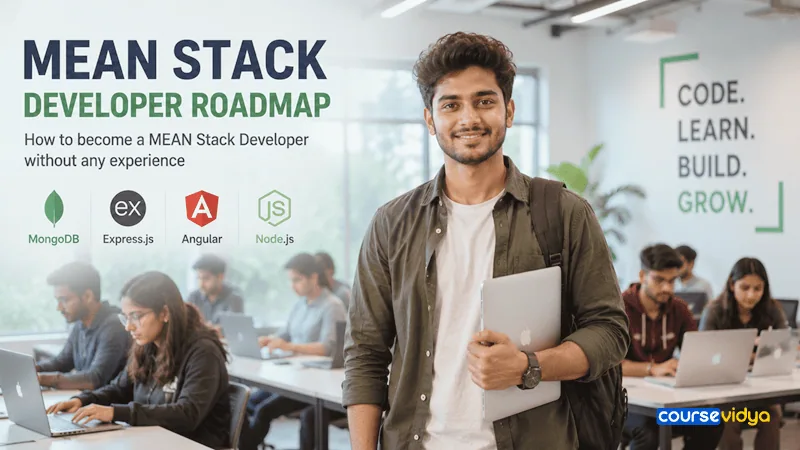
Want a MEAN Stack Developer roadmap, which can help you secure an entry-level job without any experience?
Today’s MEAN Stack job market rewards practical skills, real-world projects, and problem-solving ability over academic credentials.
This blog gives you a complete MEAN Stack Developer roadmap covering the current job market, required skills, certifications, projects, resume tips, and proven strategies to help you start your MEAN Stack career.
How AI has changed the MEAN Stack job market
A well-planned MEAN Stack Developer roadmap starts with understanding how the job market has changed in the last five years.
Five years ago, companies hired junior Mean Stack Developers for siloed tasks such as writing boilerplate code, fixing minor bugs, or creating simple HTML/CSS pages. Today, AI coding assistants such as GitHub Copilot, ChatGPT, and Claude automate much of that routine work, allowing developers to focus more on solving problems and building features. Employers increasingly expect freshers to contribute to end-to-end feature development much earlier, using modern development tools and AI coding assistants.
Below is a comparison of entry-level titles, expectations, and average starting salaries for MEAN Stack Developer roles.
| Feature / Metric | Pre-AI era | Present day |
|---|---|---|
| Typical entry-level job titles | Junior Web Developer Trainee Software Engineer Junior Frontend / Backend Developer | Associate Full Stack Engineer MEAN/MERN Stack Developer Junior AI-Assisted Full Stack Developer Junior Product Engineer |
| Core skill expectations | Basic HTML, CSS, JavaScript, simple CRUD operations, basic SQL/MongoDB. | Full-stack proficiency (Angular + Node + Express + Mongo), Git workflow, REST APIs, basic AWS/Docker, and proficiency in AI coding assistants such as GitHub Copilot, ChatGPT, and Claude. |
| UI styling, w | riting boilerplate code, and manual bug detection. | Prompting/reviewing AI-generated code, end-to-end feature ownership, API integrations, and debugging. |
| Average fresher’s MEAN Stack developer salary in India | ₹2.5 LPA – ₹4.0 LPA | ₹3.5 LPA – ₹6.5 LPA |
Note: Salaries are approximate starting ranges in India and vary based on skills, location, company type, and hiring market conditions.
MEAN Stack career path mapping
Career path mapping is an essential part of a MEAN Stack Developer roadmap because it helps freshers set realistic career goals.
1. Entry-Level (0–2 Years)
- Job Roles: Associate MEAN Stack Developer, Junior Full-Stack Engineer, Trainee Angular Developer, Junior Backend Developer (Node.js).
- Service-Based MNC Range: ₹3.5 LPA – ₹4.5 LPA
- Product Startup / Premium Range: ₹5.0 LPA – ₹7.5+ LPA
- Market Average: ₹3.8 LPA – ₹5.5 LPA
2. Mid-Level (3–6 Years)
- Job Roles: Full-Stack MEAN Engineer, Full-Stack Developer, Frontend Specialist (Angular), Node.js API Engineer.
- Service-Based MNC Range: ₹6.0 LPA – ₹8.5 LPA
- Product Startup / Premium Range: ₹9.0 LPA – ₹14.0+ LPA
- Market Average: ₹7.0 LPA – ₹9.5 LPA
3. Senior Level (6–10 Years)
- Job Roles: Senior Full-Stack Engineer, Lead MEAN Developer, Lead Full-Stack Engineer, Senior Software Engineer (Full Stack).
- Service-Based MNC Range: ₹11.0 LPA – ₹16.0 LPA
- Product Startup / Premium Range: ₹18.0 LPA – ₹30.0+ LPA
- Market Average: ₹14.5 LPA – ₹22.0 LPA
4. Expert Level (10+ Years)
- Job Roles: Principal Full-Stack Architect, Cloud and Web Platform Architect, Head of Web Engineering, Director of Engineering.
- Service-Based MNC Range: ₹24.0 LPA – ₹35.0 LPA
- Product Startup / Premium Range: ₹40.0 LPA – ₹65.0+ LPA
- Market Average: ₹35.0 LPA – ₹48.0 LPA
Note: The above salary data are approximate annual CTC projections based on the latest Indian job market trends. Your actual salary may vary depending on various factors, such as job location, company type, technical expertise, interview performance, and your experience band. Also, product companies and big startups may also offer bonuses or stock-based compensation in addition to base salary.
MERN Stack Developer roadmap for freshers: How to become a MERN Stack Developer
What educational background do freshers need for MEAN Stack Developer jobs?
How to become a MEAN Stack Developer begins with understanding the employer’s expectations regarding baseline educational requirements.
Common educational backgrounds:
- Bachelor’s degree in Computer Science (B.Tech / B.E. in CSE/IT), Computer Applications (BCA), or Information Technology (B.Sc IT).
- Non-CS engineering streams (such as ECE, EEE, or Mechanical) or general science graduates (B.Sc in Physics/Maths).
- An MCA or M.Tech provides an added advantage for specialized enterprise roles.
But a specific degree is no longer strictly required to get hired as a MEAN Stack Developer. A strong portfolio, solid JavaScript fundamentals, and hands-on projects can significantly improve your chances of securing a MEAN Stack Developer job as a fresher.
MEAN Stack Developer skills for freshers
Learning the right skills is one of the most important stages in a MEAN Stack Developer roadmap.
Core Web and Programming skills
Understanding how to become a MEAN Stack Developer requires learning JavaScript before moving to MongoDB, Express.js, Angular, and Node.js.
- HTML5 and CSS3
- Advanced JavaScript (ES6+)
- TypeScript
Required MEAN Stack expertise
The following MEAN Stack Developer skills are essential for freshers who are targeting entry-level jobs.
- MongoDB (Database Layer)
- Express.js (for Backend Framework)
- Angular (for Frontend Framework)
- Node.js (Runtime Environment)
Essential technical skills
The following technical MEAN Stack Developer skills separate job-ready candidates from theoretical learners:
- RESTful API Development and Testing
- Version Control (Git and GitHub)
- Basic Authentication and Security
- Application Deployment and Cloud Basics (e.g., Vercel, Netlify, Render, or AWS)
- AI coding assistants (such as GitHub Copilot, ChatGPT, and Claude)
- JSON and API Integration
Classroom vs online certification: which is best for fresher MEAN Stack jobs?
Understanding the difference between classroom learning and online learning is another important step in a MEAN Stack Developer Roadmap.
The following table highlights the key differences between classroom MEAN trainings and online certification programs.
| Feature | Classroom MEAN Stack training | Online MEAN Stack courses |
|---|---|---|
| Flexibility | Fixed schedule and location | Self-paced or instructor-led; learn from anywhere |
| Cost | Higher (tuition and commute) | Generally lower and budget-friendly |
| Interaction | Face-to-face discussions and networking | Live classes, mentor sessions, communities, and forums |
| Doubt solving | In-person support | Delayed via chats/tickets |
| Best for | Learners who prefer structured classroom guidance | Self-disciplined learners, students, career changers, and working professionals |
Find the best MEAN Stack training institutes near you
Best online MEAN Stack certifications for freshers
How to become a MEAN Stack Developer also involves earning recognized certifications that strengthen your technical profile.
MongoDB Associate Developer Exam
Cost: Paid
The MongoDB Associate Developer certification can be a valuable addition to your MEAN Stack Developer roadmap.
The certification is offered by MongoDB. Candidates can prepare through MongoDB’s official learning platform and practice using MongoDB Atlas.
This certification evaluates MongoDB fundamentals, including data modeling, CRUD operations, aggregation, indexing, MongoDB Atlas concepts, and application development using MongoDB drivers. It validates your understanding of MongoDB and NoSQL database fundamentals to prospective employers. You can prepare for this exam through MongoDB University and practice on MongoDB Atlas for free.
Junior Angular Developer Certification
Cost: Paid
The Junior Angular Developer Certification is offered by Certificates.dev and developed with contributions from Google Developer Experts (GDEs).
This entry-level certification assesses knowledge of Angular concepts, including components, TypeScript, RxJS, Reactive Forms, and single-page application development. This certification can strengthen your resume when applying for entry-level MEAN Stack Developer roles.
AWS Certified Cloud Practitioner
Cost: Paid
Administered by Amazon Web Services (AWS), this certification demonstrates foundational AWS cloud knowledge and can strengthen your profile when applying for MEAN Stack Developer jobs.
It covers IAM, core AWS services such as EC2 and S3, security, pricing, and architectural concepts. It demonstrates a foundational understanding of AWS cloud services, security, pricing, and core deployment concepts, which can strengthen a fresher’s profile. You can learn this exam via AWS Skill Builder – Cloud Practitioner Essentials.
How to become a Golang Developer: A comprehensive Golang Developer Roadmap to secure your first job
Fresher-friendly MEAN Stack projects for portfolio
How to become a MEAN Stack Developer involves gaining practical knowledge by building real-world projects. Projects help recruiters evaluate your ability to apply MEAN Stack concepts, build functional applications, and follow real-world development practices.
To stand out in the interview process, consider building the following MEAN Stack projects for your portfolio.
- E-Commerce Platform with Payment Gateway: Online store featuring product search, cart management, user authentication, and optional payment gateway integration.
- Role-based Task and Team Dashboard: A workspace app with secure login, role-based access control, task assignments, and file uploads.
- Real-Time Collaboration App: A real-time collaboration app using WebSockets/Socket.IO for live messaging, group chat rooms, and notifications.
- AI-Powered Blogging or Note App: Content platform integrating AI APIs for features such as summarization, categorization, or content assistance.
Once you complete your projects, upload the code to a GitHub repository and deploy your Angular frontend using platforms such as Vercel or Netlify, host your Node.js/Express backend using platforms such as Render, and use MongoDB Atlas for database hosting.
Career opportunities for MEAN Stack Developers
Targeting the right job roles and internship opportunities is an important phase of a MEAN Stack Developer roadmap.
Once you have built MEAN Stack projects for your portfolio, you should review suitable job titles for freshers and the expected MEAN Stack Developer salary for those roles.
| Job title target | Focus area | Salary range in India |
|---|---|---|
| Associate MEAN Stack Developer | Complete end-to-end web applications | ₹3.5 LPA – ₹6.5 LPA |
| Trainee / Junior Angular Developer | Frontend components, RxJS, and UI logic | ₹3.0 LPA – ₹5.0 LPA |
| Junior Backend Developer (Node.js) | REST APIs, database queries, and routing | ₹3.2 LPA – ₹5.5 LPA |
| Full-Stack Software Engineering Intern | Bug fixes, small feature updates, testing | ₹1.2 LPA – ₹4.0 LPA |
Internships can significantly improve your chances of getting full-time MEAN Stack Developer jobs by providing practical experience and industry exposure. You should use Internshala, LinkedIn, Wellfound (formerly AngelList Talent), and Unstop (formerly Dare2Compete) for MEAN Stack internships.
Networking and referrals tips for MEAN Stack freshers
Networking and referrals should be included in every MEAN Stack Developer roadmap to improve interview opportunities. Start by building a complete LinkedIn profile that showcases your live MEAN Stack projects and includes a GitHub link. Send personalized connection requests to developers, tech leads, recruiters, and engineering managers while engaging meaningfully with their posts or company updates.
Share 30-second video walkthroughs or code snippets of your projects publicly on LinkedIn to build credibility. Join active developer communities on GitHub, LinkedIn, Discord, Reddit, and X (Twitter) to learn from experienced developers, contribute to discussions, and discover job opportunities.
Tips for MEAN Stack resume and interview preparation
How to become a MEAN Stack Developer also depends on preparing an ATS-friendly resume and preparing for interviews.
To build an ATS-friendly resume, consider the following tips.
- Keep your resume to one page.
- Use a simple single-column design to improve readability for recruiters and compatibility with most ATS systems.
- Focus on listing skills and projects clearly.
- Place GitHub repositories and deployed application links (such as Vercel, Netlify, Render, or other hosting platforms) near the top.
For interviews, strong proficiency in core JavaScript fundamentals is essential. Practice coding problems on platforms such as HackerRank, LeetCode, or CodeSignal, and prepare to answer interview questions on JavaScript, Angular, Node.js, REST APIs, and databases. Be prepared to walk through your project architecture step by step.
Conclusion
The demand for skilled MEAN Stack developers continues to grow despite changing hiring trends and AI advancements. As a fresher, focus on building a strong portfolio, earning recognized certifications, networking with professionals, and preparing for interviews. With persistence and the right MEAN Stack Developer roadmap, freshers can confidently secure their first MEAN Stack developer job.
To find top-quality MEAN Stack training institutes, visit CourseVidya.com, India’s own course search engine. Check out the AI demand score, prices, and facilities only on CourseVidya.com.