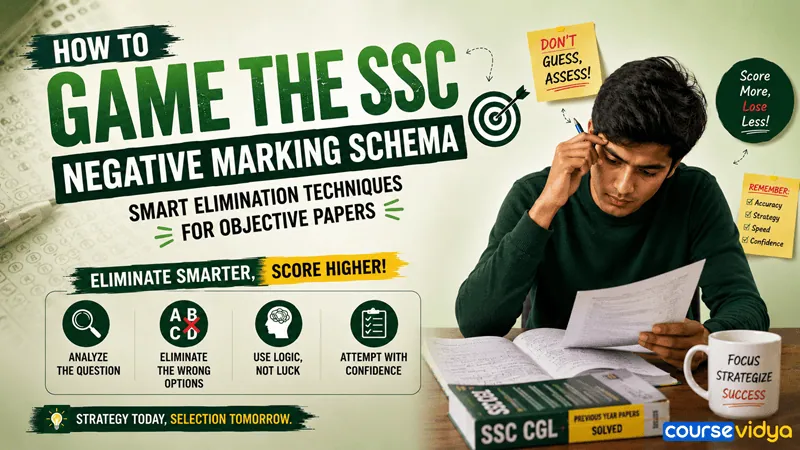
Are you an SSC aspirant terrified of losing hard-earned marks to negative marking rules? How can you systematically avoid negative marking in SSC?
First of all, you should know that you are not alone.
Many SSC candidates lose critical marks due to the negative marking rule. If you answer a question incorrectly, it leads to a deduction. As a result, you end up with a lower rank than you expected.
In light of the latest negative marking rules in SSC exams, attempting objective questions with just guesswork is risky. You can significantly improve your score by recognizing patterns and eliminating wrong choices. By mastering the smart MCQ elimination method and guessing techniques, you can power your way through to SSC success.
Understanding the SSC negative marking rule
The SSC examination follows a strict negative marking rule to evaluate candidates’ decision-making ability and accuracy. The negative marking strategy has levied -0.50 marks deduction for every wrong answer. You earn 2 marks for every right answer and zero penalties for unattempted questions.
In addition to the negative marking rule, a strict sectional time limit has made blind guessing incredibly risky for SSC aspirants.
Despite understanding the dangers of randomly choosing an answer, many aspirants end up doing exactly that under time pressure. Additionally, fear of negative marking also leads to hesitation in attempting or skipping questions. This creates a cycle of fear and overthinking, which affects your SSC score.
This is why you need smart elimination tricks and guessing techniques to strengthen your correct intuition and reduce the negative marking in the SSC exam.
Why most SSC aspirants get negative marks?
A lack of an SSC preparation strategy is why candidates lose critical marks under the negative marking rule. They randomly guess the MCQs’ answers without any appropriate elimination method. SSC aspirants often get stuck with tricky questions and rush through the remaining options, unthinkingly guessing.
Students often mark answers they are not completely sure about, and more often than not, they turn out to be wrong. They often miss the most numerical and linguistic cues, completely ignoring elimination tricks.
Lack of regular practice to avoid negative marking in SSC is another reason behind aspirants missing the cutoff. They are unable to identify patterns in the questions due to limited practice, resulting in lower accuracy.
Smart MCQ elimination method for SSC aspirants to reduce negative marks
The MCQ option-elimination method can help to identify incorrect options even when you are faced with a completely unfamiliar question. In competitive exams, aspirants often use these techniques to increase their attempt rate safely while taking calculated risks. There are ways to deploy this smart SSC option elimination method across English, Quant, and General Awareness.
Identify extreme words in General Awareness
General awareness is heavily penalized among SSC aspirants due to its vast syllabus. Questions across this section often include options with extreme words, such as “None”, “Completely”, “Always”, “Never”, or “Only”, which are usually incorrect.
On the other hand, words like “May”, “Generally”, “Often”, and “Some” are safer choices and can be the correct answer.
Option elimination trick for Quantitative Aptitude
Quantitative Aptitude can eat into your sectional time if you try to solve a problem step-by-step before finding the correct answer. Before starting to calculate a complex and lengthy problem, do the following steps:
- The outlier: Among the options, if one is radically different from the others, then it is almost always the wrong option.
- Divisibility check: If you calculate the volume of a cylinder or area of a circle using 22/7 for π with whole numbers, the calculation introduces a factor of 11, which means your final answer will often be a multiple of 11. So, before fully solving the question using a formula, check the options for divisibility by 11 as a quick shortcut to eliminate wrong choices.
Structural logic for English
While solving the English section in the SSC exam, you can come across an unfamiliar word in fill-in-the-blank questions or a closed test. If you don’t know the meaning, follow this strategy:
- First, examine the sentence carefully. If the sentence is in the simple present tense and the subject is a third-person singular pronoun or noun, MCQ options that do not include an s/es suffix on the base verb are incorrect.
- Then check the tense; if the paragraph is in the past tense, options that do not align with the tense are wrong.
- If you come across a sentence that lists attributes separated by commas, and it contains three nouns and one adjective, then the missing word is most likely to be an adjective.
How to rebuild your SSC CGL preparation strategy during your drop year – a step-by-step study plan
Smart guessing technique to avoid negative marks in SSC
The difference between blind guessing and smart guessing lies in logic. Smart guessing is based on partial knowledge, pattern recognition, and elimination, making it part of an effective SSC negative-marking elimination strategy. Smart guessing is essential for competitive exams, as they often have a vast syllabus and unfamiliar questions are common.
During the SSC exam, you will come across questions where you are partially sure or completely unsure about the given options. There is a smart guessing technique for competitive exams that SSC toppers use to optimize their accuracy and drastically reduce negative marking.
| Scenario | Probability of Success | Expected Value Calculation | Statistical Outcome | Correct Action Plan |
|---|---|---|---|---|
| 2 Unknown Options (2 eliminated) | 50% (1 in 2) | (1/2 × 2) + (1/2 × -0.5) = +0.75 | Net Positive | Always Attempt |
| 3 Unknown Options (1 eliminated) | 33.33% (1 in 3) | (1/3 × 2) + (2/3 × -0.5) = +0.333 | Marginal Gain (High Real-World Risk) | Avoid (Unless near cutoff) |
| 4 Unknown Options (0 eliminated) | 25% (1 in 4) | (1/4 × 2) + (3/4 × -0.5) = +0.125 | Zero to Negligible Gain | Always Avoid |
Follow this table while faced with unknown options and never skip a question if there is a 50/50 probability.
Psychological negative marking elimination method for SSC aspirants
SSC aspirants often panic during the exam when they encounter unfamiliar questions. Emotional stress and panic are common among the candidates due to the heightened pressure in the competitive exams in India. It often leads to rushing through questions, resulting in negative marking in exams like the SSC. Besides academic preparation, you need to prepare psychologically. Remember to stay calm and use your guess-and-eliminate method when you encounter an unfamiliar question.
When you face a complex question, you don’t have to answer it immediately. You should move to the known questions and leave them for later. Do not change your answer at the final moments of your exam, and do not second-guess your choices. It will increase your self-doubt and decrease your confidence.
Common mistakes to avoid to reduce negative marking in SSC
- Overthinking simple MCQs: SSC aspirants often search for hidden clues in simple questions and talk themselves out of the obvious correct answer. It often happens due to self-doubt and low confidence.
- Stay stuck with a single question: Candidates often fixate on a single Quant problem for more than 90 seconds, wasting precious time and confidence on the rest of the questions.
- Not reading properly: SSC aspirants often forget to check all the options provided with a question. They mark the one they think is the right answer without even studying the other options. It often results in silly mistakes and negative marking.
- Guessing without elimination: Candidates often click an answer choice without even eliminating two choices. You should actively apply the MCQ elimination method for SSC to avoid losing marks.
Conclusion
Securing success in the SSC exam requires discipline and consistency in attempting full-length mock tests. It allows you to test your guessing and elimination strategy. Just reading about the techniques is not sufficient to execute them perfectly on the exam day.
You must include mock tests and solving previous years’ questions (PYQs) in your SSC preparation strategy, and use your option-elimination techniques and guessing methods. Repetitive practice enhances your ability to execute it seamlessly in the actual exam. Track your accuracy as you start implementing smart-guessing and elimination techniques to reduce negative marking in SSC. Stop leaving easy marks on the table. Increase your attempt rate while enhancing accuracy in SSC with the smart MCQ elimination and guessing method described in this blog.