How do you learn Cyber Security for free?
You don’t need to register for an expensive boot camp or a formal degree to break into the tech defense industry. In recent years, the Cyber Security industry has seen abundant job opportunities, with salaries in the premium range and strong long-term career growth potential.
If you want to fast-track your progress in Cyber Security, you need to know exactly what resources, tools, and practice labs you need to use. Stop being confused by the millions of free resources and tools available online.
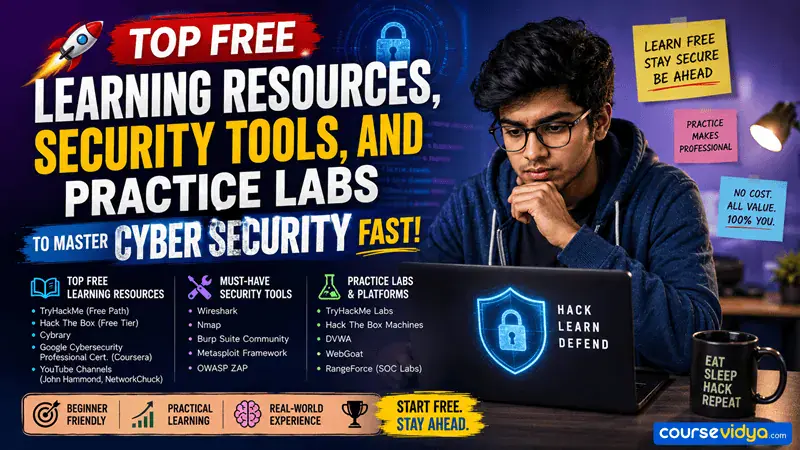
This guide brings together top free learning resources, practical labs, and open-source security tools to help you build your skills quickly. Whether you are a beginner or looking to strengthen your basics first, follow this ultimate free guide to Cyber Security.
Why is learning Cyber Security important nowadays?
Cybersecurity is a growing field in today’s digital-first world, with the potential to earn premium salaries. Companies are seeking skilled professionals for high-paying roles such as SOC analysts, ethical hackers, and penetration testers.
However, the cybersecurity industry no longer needs theoretical knowledge from textbooks. Hiring managers and recruiters are looking for practical troubleshooting skills and hands-on experience to understand how cyberattacks occur and how defenses work in the real world. That is why you need to use open-source tools and practice labs to build a professional skill set.
Best free Cyber Security learning resources
Choosing the right learning resources is a step toward building a strong foundation for learning Cyber Security. You need to learn various core concepts, such as system defense, networking, and security principles, in a structured way rather than consuming content randomly.
Beginner-friendly platforms for learning
- Google Cybersecurity Professional Certificate: This program is available via Coursera and covers Python, SQL, Linux, and Security Information and Event Management (SIEM) tools. Despite being a paid course, you can audit all the learning materials for free, or you can apply for the built-in financial aid to earn an official batch at no cost.
- Cybrary and edX: edX is highly beneficial for beginners as it lets you audit university-level cybersecurity programs from institutions like MIT and Harvard for free. On the other hand, Cybrary offers beginners a structured path to enter the corporate world.
- Professor Messer’s CompTIA Security+ (SY0-701): It is a free Cyber Security course with core exam objectives. You can access his study materials and video training from his official website or his YouTube channel. This course is highly regarded for its high-standard entry-level security theory and foundational network.
- Khan Academy: This platform offers free modules on the basics of computing and networking, helping you create a solid foundation for your Cyber Security journey.
Free documentation and open learning
- SANS Institute Free Resources: SANS Institute offers high-quality community webcasts, cheat sheets, and white papers from top-tier instructors at no cost.
- The OWASP Foundation is a non-profit dedicated to enhancing software security. This foundation offers a variety of free open-source tools and educational resources. You can review their official documentation on secure coding standards. You can also download OWASP WebGoat, a deliberately designed, insecure application for learning web application security in a safe, offline sandbox.
The best way to learn Cyber Security is to combine hands-on experience with structured theory knowledge. Combine these resources mentioned above with practical learning to consolidate your Cyber Security learnings.
Best open-source Cyber Security tools for beginners
Learning Cyber Security as a beginner is most effective when it’s paired with real tools experience. Beginner-friendly security tools help you understand how attackers exploit systems and how networks behave in the real world.
Network and scanning tools
- Wireshark: It works as a network protocol analyzer that captures and inspects network traffic. It is an open-source tool that enables Cyber Security professionals to monitor traffic in real-time, identify malicious activity, and trace communication errors.
- Nmap: It is an open-source utility used for security auditing and network discovery. It maps networks for identifying running services, operating systems, open ports, and connected devices. It will help you determine what operating systems are running on a local subnet and discover active hosts.
Vulnerability and security testing tools
- Burp Suite Community Edition: It is a manual toolkit for web application security testing and ethical hacking. It offers manual testing utilities and an intercept proxy for inspecting and manipulating HTTP(S) traffic. It’s a free tool that allows you to modify live web traffic and identify hidden security flaws.
- Metasploit Framework: It is a Ruby-based platform for penetration testing that discovers, validates, and exploits system vulnerabilities. This is an open-sourced tool that supports the entire attack lifecycle, starting from initial network scanning to post-exploitation and privilege escalation.
Open-source ecosystem and auditing
- The Kali Linux Ecosystem: It is a Debian-based Linux distribution for ethical hacking, penetration testing, and digital forensics. It serves as an industry-standard security platform that minimizes the need to configure tools manually. You can use Kali Linux to run pre-packaged security testing tools rather than installing them individually.
- John the Ripper: It is one of the most used and open-sourced password recovery and security auditing tools. It helps identify how attackers compromised the system by exploiting cracked password hashes.
Online free practice labs
Practicing platforms for beginners
- TryHackMe: This platform is highly accessible and offers hands-on experience for beginners, with learning structured around badges, points, and global leaderboards. It also features comprehensive learning paths from pre-security to roles like SOC analyst and penetration tester.
- Hack The Box offers a gamified experience for both defensive and offensive hacking. When you are ready to shift toward unguided penetration testing, this platform is essential. Additionally, it offers industry-recognized certifications, interactive labs, and guided modules.
Blue team ranges and web security
- CyberDefenders: It is a specialized training and certification platform for aspiring incident responders and SOC analysts. It features real-world digital forensics and incident response (DFIR).
- OWASP Juice Shop: This is a modern JavaScript web application deliberately made vulnerable. It provides a self-contained, safe environment for beginners to practice reverse engineering and defensive configuration.
- PortSwigger Web Security Academy is an industry-recognized, free learning platform for ethical hacking and web application security. It offers you access to a deliberately vulnerable environment to safely practice SQL injection, CSRF, and XSS.
Learning Cyber Security faster with a step-by-step plan
If you are a beginner starting your cybersecurity journey, you should begin by learning operating systems, networking, and Linux fundamentals. After building a strong foundation, you can move on to security concepts. You must use beginner-friendly tools like Nmap and Wireshark to learn network scanning and traffic analysis. Use the TryHackMe and HackTheBox platforms for daily practice to build real-world experience. After that, you can explore OWASP labs and Burp Suite.
Conclusion
With the availability of free learning platforms, hands-on practice labs, and free security tools, learning Cyber Security has never been more accessible. You don’t need to invest a lot of money; you need commitment and curiosity. Free sandboxes like TryHackMe and open-source tools like Wireshark offer you real and referenceable experience. You need to stop learning theories only. Use the sandboxes and build an unignorable portfolio. Choose one platform from this guide and start today.