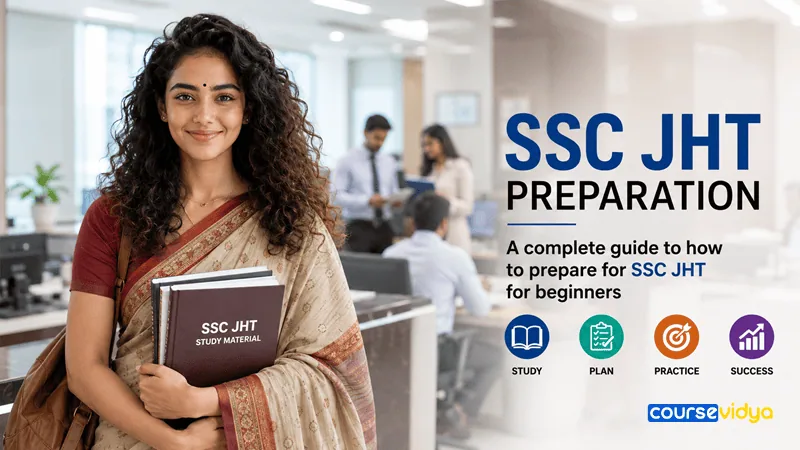
Unsure about starting your SSC JHT preparation?
If you are a beginner and want to crack the exam on your first attempt, you must start your preparation by learning the SSC JHT syllabus and exam pattern.
Once you do that, you will need a proper study plan that will help you cover the syllabus while balancing grammar, vocabulary, translation, and essay writing.
Our month-wise study plan covers every stage of your journey, from building strong basics to mastering translation and taking mock tests for successful SSC JHT preparation.
SSC JHT exam pattern
Knowing the SSC JHT exam pattern is the first step in preparing for the exam. The SSC JHT exam pattern helps you understand the number of papers, subjects, mark distribution, and time limit.
The Staff Selection Commission (SSC) Combined Hindi Translators Examination, commonly referred to as the SSC JHT exam by aspirants, has two papers.
- Paper-I (Objective Test)
- Paper-II (Descriptive Test)
Candidates who meet the minimum qualifying marks and are shortlisted based on their Paper-I performance can appear for Paper-II. For the final merit list, 50% of Paper-I marks and 100% of Paper-II marks are counted, giving a total of 300 marks.
SSC JHT exam pattern for Paper-I
SSC JHT Paper-I tests candidates’ knowledge of Hindi and English, including correct use of words, phrases, and idioms, and their ability to write the languages correctly, precisely, and effectively at the degree level.
| Feature | Details |
|---|---|
| Exam mode | Computer-Based Test (CBT) |
| Question type | Multiple Choice Questions (MCQs) |
| Sections | General Hindi (100 Marks) and General English (100 Marks) |
| Total questions | 200 Questions |
| Total marks | 200 Marks |
| Total duration | 2 Hours (with 1-hour sectional timing per section) |
| Marking scheme | +1 mark for each correct answer |
| Negative marking | -0.25 marks for every incorrect answer |
Minimum qualifying standards for SSC JHT Paper-I
Candidates must meet the minimum qualifying percentage prescribed by SSC; however, actual shortlisting for Paper-II is based on category-wise cutoffs in Paper-I.
- Unreserved (UR): 30%
- OBC / EWS: 25%
- SC / ST / PwD / Others: 20%
SSC JHT exam pattern for Paper-II
SSC JHT Paper-II evaluates translation skills and the ability to write and comprehend Hindi and English correctly, precisely, and effectively. This paper evaluates candidates’ translation skills in both Hindi and English.
| Component | Task details | Total marks | Duration |
|---|---|---|---|
| Translation Passage 1 | Hindi to English Translation | — | 2 hours (cumulative for all 4 tasks) 2 hours 40 minutes for candidates eligible for use of a scribe |
| Translation Passage 2 | English to Hindi translation | — | |
| Essay Writing 1 | Hindi Essay | — | |
| Essay Writing 2 | English Essay | — | |
| Total | Translation + Essay | 200 marks |
Final merit and Tie-breaking rule
Selection score: Final merit is determined using 50% of Paper-I marks and 100% of Paper-II marks. Since Paper-I carries 200 marks and Paper-II carries 200 marks, the effective merit weightage is 100 marks from Paper-I and 200 marks from Paper-II, totaling 300 marks.
Tie-breaker hierarchy: If two or more candidates obtain equal aggregate marks, ties are resolved in the following sequential order:
- Higher marks obtained in Paper-II (Descriptive Exam).
- Seniority in age (older candidate ranked higher).
- Alphabetical order of candidate names.
JAIIB preparation: How to prepare for JAIIB effectively and systematically for success
SSC JHT syllabus
Knowing the SSC JHT syllabus is important because it outlines what to study, which skills are tested, and how to prepare effectively for the SSC JHT. Paper-I questions are of degree level, while Paper-II is at a level consistent with the educational qualifications prescribed for the posts.
SSC JHT syllabus for Paper-I: Important topics to prepare
SSC JHT Paper-I has two equal sections:
- General Hindi (100 Marks)
- General English (100 Marks)
| Subject | Important topics | Focus areas and question types |
|---|---|---|
| General Hindi | हिन्दी व्याकरण (Hindi Grammar) शब्द ज्ञान (Vocabulary) मुहावरे एवं लोकोक्तियां (Idioms and Proverbs) पर्यायवाची एवं विलोम शब्द (Synonyms and Antonyms) वाक्यों का सुधारीकरण (Sentence Correction) कारक, विभक्ति, समास एवं संधि (Grammar Concepts) अपठित गद्यांश (Comprehension Passage) | Error spotting in Hindi sentences Correct use of कारक, विभक्ति, and other grammatical structures Sentence restructuring and filler questions Identifying gender, number, and tense shifts Passage reading and contextual comprehension |
| General English | English Grammar Rules Vocabulary and Word Power Synonyms and Antonyms Idioms and Phrases / One-Word Substitution Sentence Structure and Completion Tenses, Articles, and Prepositions Active/Passive Voice and Direct/Indirect Speech Unseen Passage / Reading Comprehension | Spotting errors in English prose Cloze test and fill in the blanks Identifying spelling mistakes and wrong usage Reordering jumbled sentences (Para Jumbles) Passage-based factual and inferential questions |
SSC JHT syllabus for Paper-II: Important topics to prepare
| Section | Task description | Preparation focus |
|---|---|---|
| Translation: Hindi to English | Translate a continuous prose passage from Hindi into English. | Accuracy and fidelity of translation Appropriate English vocabulary for Hindi terms Correct tense and voice usage |
| Translation: English to Hindi | Translate a continuous prose passage from English into Hindi. | Natural Hindi sentence phrasing (Shuddh Hindi) Precise rendering of technical or administrative terms Preservation of tone and context |
| Essay Writing (Hindi) | Write one descriptive essay in Hindi on a given topic (social, administrative, national, or contemporary affairs). | Clarity of expression and logical structure Appropriate Hindi vocabulary and correct spelling Coherence of arguments and essay formatting |
| Essay Writing (English) | Write one descriptive essay in English on a given topic (current issues, policy, culture, or general knowledge). | Conceptual clarity and persuasive writing Grammatical precision and sentence variety Concise paragraph management |
How to prepare for MH SET: A complete MH SET preparation guide for beginners
A month-wise SSC JHT preparation guide
After you have carefully gone through the SSC JHT syllabus and exam pattern, it’s time to begin your exam preparation. A month-wise SSC JHT preparation plan can be particularly useful for absolute beginners because it provides a structured timeline to cover the syllabus, practice, and revise.
Month 1: Covering the basics
The goal of the 1st month of SSC JHT preparation is to establish daily habits. Solidifying core concepts and bridging basic language gaps in both Hindi and English are among the most important steps in preparing for the SSC JHT.
Learning basic grammar rules
Your SSC JHT preparation strategy for the first 3 weeks of month 1 involves studying English and Hindi grammar rules and focusing on common error patterns.
Focusing on Vocabulary
You will maintain a language notebook and record around 10 new words, idioms, synonyms, and antonyms each day across Hindi and English.
Daily reading
One useful SSC JHT preparation strategy is to read an English newspaper, such as The Hindu or The Indian Express, and a Hindi daily, such as Dainik Jagran or Navbharat Times. You should dedicate at least 30 minutes each day and pay close attention to editorial sentence structures.
Taking the diagnostic test
You will solve one full-length SSC JHT Previous Year Question paper (PYQ) at the end of this month. You don’t need to maintain strict timing as the aim is to understand your current level of preparation and identify weak areas.
Month 2: Sectional practice and Translation
If you want to learn how to prepare for SSC JHT exam, you must shift your focus toward the application. In the 2nd month, your SSC JHT preparation guide focuses on improving your speed in Paper-I while starting basic translation practice for Paper-II.
Daily practice for SSC JHT Paper-I
You will solve 50–60 MCQs daily across English and Hindi. Focus on grammar, vocabulary, sentence usage, comprehension, and other question types relevant to the SSC JHT Paper-I syllabus, including areas such as error spotting, cloze-type questions, and Hindi grammar topics such as कारक and समास.
Learning Translation for SSC JHT Paper-II
Your SSC JHT study plan for Month 2 will include 45 minutes of basic translation practice daily. Start with individual complex sentences, then gradually move to short passages, and finally to longer prose passages. You must practice translating from Hindi to English and vice versa.
Administrative Vocabulary
In the 2nd month, begin building a list of commonly used official and administrative terminology to improve your accuracy when translating government-related content.
Weekly sectional tests
In this stage, you will take 2 sectional tests every week for Paper-I to measure your topic-wise accuracy. You will also track your mistakes and note them down.
Month 3: Essay practice and full-length SSC JHT mock tests
Your SSC JHT preparation strategy for the 3rd month will be completely focused on building speed for Paper-I and practicing essay writing.
SSC JHT mock tests for Paper-I
Your SSC JHT study plan should include 2–3 full-length Paper-I mock tests per week under the official 2-hour time limit.
Essay Writing
An effective SSC JHT preparation plan should include writing at least 2 essays per week (1 in Hindi, 1 in English). For practice, aim to write essays of around 400–500 words and initially allocate about 35 minutes per essay. Adjust the word count and time allocation as your speed improves.
Passage translation
You will also practice translating longer prose passages three times a week, focusing on natural phrasing rather than literal word-for-word translation.
SSC JHT mock tests analysis
After every mock test, spend sufficient time analyzing each mock test, ideally around 1 hour for a full-length test. You will revise the weak topics and reattempt the questions.
Month 4: Revision and exam readiness
Aspirants who are searching for how to prepare for SSC JHT exam should dedicate the final month to improving writing speed, accuracy, time management, and exam readiness.
Revision cycles
In the final phase, your SSC JHT preparation plan must include revising vocabulary, administrative terminology, and grammar rule notes every morning.
SSC JHT mock tests for Paper-II
You will attempt full Paper-II practice tests covering two translation passages and two essays under the official overall time limit.
Final Paper-I preparation
You can attempt a full-length mock test every alternate day during the last month, depending on your preparation level and the time available for analysis. But consider stopping new full-length mocks 3–4 days before the exam and use that time for revision, error review, and light practice.
Revising weak areas
During the final 10 days, prioritize your weak areas while continuing targeted revision, PYQ review, and timed Paper-II practice.
REET Preparation: A month-wise roadmap on how to prepare for REET Level 1 and Level 2 exams
Conclusion
Candidates searching for how to prepare for SSC JHT exam often struggle to create a structured preparation plan. As a beginner, you must first clearly understand the SSC JHT syllabus and exam pattern, then begin your preparation.
Start your SSC JHT preparation today with our month-wise plan to cover the syllabus systematically and improve your exam readiness.
To find the best SSC JHT coaching centers, visit CourseVidya.com to compare coaching centers, explore course fees and reviews, and find the best institute for your SSC JHT preparation. Click on CourseVidya.com, India’s own course search engine.