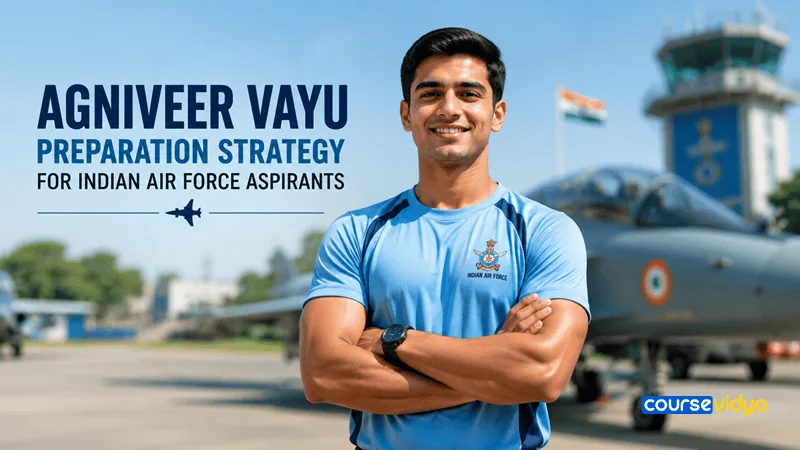
Looking for an appropriate Agniveer Vayu preparation strategy?
The Indian Air Force Agniveer Vayu recruitment offers young aspirants a chance to build a rewarding career in the Air Force.
However, success requires a well-planned preparation strategy that covers the syllabus and exam pattern, practicing mock tests, and managing time effectively.
Follow this guide to Agniveer Vayu preparation to maximize your chances of joining the Indian Air Force on your first attempt.
Agniveer Vayu exam pattern
The first step in learning how to crack Agniveer Vayu is understanding its exam pattern. The Indian Air Force Agniveer Vayu selection process consists of three broad phases:
- Phase 1: Online computer-based test (CBT)
- Phase 2: Physical Fitness Test (PFT), document verification, and adaptability tests
- Phase 3: Medical examination
The Agniveer Vayu online test is conducted in three stream categories based on a candidate’s educational qualifications:
- Science (formerly Technical / Group ‘X’)
- Other Than Science (formerly Non-Technical / Group ‘Y’)
- Science and Other Than Science (Group ‘X and Y’)
Agniveer Vayu exam pattern for all streams
Before starting your preparation, review the Agniveer Vayu exam pattern in detail to understand the number of questions, exam duration, and marking scheme.
The Agniveer Vayu exam has a negative marking of -0.25 for each wrong answer, and a fixed time duration for each stream/category. It requires candidates to secure the minimum qualifying marks prescribed by the Indian Air Force to become eligible for Phase II.
| Stream/category | Subjects included | Total questions | Total marks | Total time |
|---|---|---|---|---|
| Science subjects | English Mathematics Physics | 20 25 25 | 70 | 60 mins |
| Other Than Science subjects | English RAGA (Reasoning and General Awareness) | 20 30 | 50 | 45 mins |
| Both streams combined | English Mathematics Physics RAGA | 20 25 25 30 | 100 | 85 mins |
Agniveer Vayu Eligibility Criteria
Agniveer Vayu eligibility criteria help candidates understand the age limit, educational qualifications, medical standards, physical requirements, and other conditions they must satisfy before applying.
Age limit and marital status
| Parameter | Official requirement |
|---|---|
| Minimum age | 17.5 years at the time of enrolment |
| Maximum age | 21 years at the time of enrolment |
| Marital status | Only unmarried male and female candidates are eligible to apply. Candidates must commit to remaining unmarried throughout the 4-year tenure. |
Educational qualifications
Agniveer Vayu aspirants can apply under the following streams:
- Science
- Other Than Science
- Combined
Candidates must also satisfy the minimum aggregate and English marks prescribed under the Agniveer Vayu eligibility criteria.
| Stream | Minimum qualification | Mandatory scores |
|---|---|---|
| Science | 10+2 (Maths, Physics, English) OR 3-Yr Engg Diploma OR 2-Yr Vocational Course | 50% Aggregate + 50% in English |
| Other Than Science | 10+2 / Intermediate in any stream OR 2-Yr Vocational Course | 50% Aggregate + 50% in English |
Physical and fitness standards
| Standard | Male | Female |
|---|---|---|
| Height | Min. 152.5 cm | Min. 152 cm (147 cm for candidates from North-East states and hilly regions of Uttarakhand; 150 cm for candidates from Lakshadweep.) |
| Chest | Min. 5 cm expansion | Min. 5 cm expansion |
| 1.6 km Run | 7 Minutes | 8 Minutes |
| Routines | 10 Push-ups, 10 Sit-ups, 20 Squats | 10 Sit-ups, 15 Squats |
| Vision/Surgeries | 6/12 correctable to 6/6. LASIK/PRK is strictly NOT allowed. | |
Agniveer Vayu syllabus
Candidates who are searching for how to crack the Agniveer Vayu exam should start by understanding the syllabus to know the topics and subjects covered in the exam.
The Agniveer Vayu exam tests conceptual knowledge based on the CBSE 10+2 Science syllabus, while RAGA assesses reasoning ability, numerical aptitude, and general awareness at an appropriate secondary-school level.
Agniveer Vayu syllabus for English
| Category | Topics |
|---|---|
| Comprehension | Reading comprehension, including questions based on passages. (main idea, inferences, and context-based vocabulary). |
| Grammar Basics | Subject-Verb Concord, Tenses, Prepositions, Determiners, Articles, Conjunctions, Modals, and Clauses. |
| Grammar Transformation | Active and Passive Voice, Direct and Indirect Narration, Affirmative/Negative conversions, Degrees of Comparison. |
| Vocabulary | Synonyms, Antonyms, One-Word Substitution, Idioms and Phrases, Spelling Errors, and Frequently Confused Words. |
Agniveer Vayu syllabus for Physics
| Modules | Topics |
|---|---|
| Mechanics and Motion | Units and Measurements, Kinematics, Laws of Motion, Work, Energy and Power, System of Particles and Rigid Body Motion, Gravitation. |
| Properties of Matter and Heat | Bulk Matter Properties, Thermodynamics, Behavior of Gases, and Kinetic Theory. |
| Oscillations and Waves | Simple Harmonic Motion (SHM), Wave propagation, Sound Waves. |
| Electricity and Magnetism | Electrostatics, Current Electricity, Magnetic Effects of Current, Magnetism, Electromagnetic Induction (EMI), Alternating Currents (AC). |
| Optics and Modern Physics | Ray and Wave Optics, Electromagnetic Waves, Dual Nature of Matter/Radiation, Atoms and Nuclei, Electronic Devices (Semiconductors). |
Agniveer Vayu syllabus for Mathematics
| Modules | Topics |
|---|---|
| Algebra and Sequences | Sets, Relations and Functions, Complex Numbers, Quadratic Equations, Permutations and Combinations, Binomial Theorem, Sequences and Series (AP and GP), Matrices and Determinants. |
| Coordinate Geometry | Straight Lines, Circles, Conic Sections (Parabola, Ellipse, Hyperbola), 3D Geometry. |
| Calculus | Limits and Continuity, Differentiation, Applications of Derivatives, Indefinite and Definite Integrals, Applications of Integrals, Differential Equations. |
| Vectors and Probability | Vector Algebra, Basic Probability, Statistics. |
Agniveer Vayu syllabus for RAGA (Reasoning and General Awareness)
| Area | Topics |
|---|---|
| Reasoning (Verbal and Non-Verbal) | Number and Alphabet Series, Coding-Decoding, Blood Relations, Distance and Direction Sense, Analogy, Mathematical Operations, Dictionary Words, Non-Verbal Spatial Reasoning (Pattern Completion, Figure Series). |
| Numerical Ability (Basic Maths) | Ratio and Proportion, Average, LCM and HCF, Profit and Loss, Percentage, Simple Trigonometry, Time, Speed and Distance, Simplification, Basic Geometry (Area and Surface Volume of basic shapes). |
| General Awareness and Current Affairs | National and International Current Events, Basic Indian History, Geography, Civics/Constitution, Basic General Science (10th level), Sports, Awards, Basic Computer Operations. |
Agniveer Vayu preparation strategy: Month-wise preparation guide
Proper preparation is essential for beginners to succeed in the Indian Air Force Agniveer Vayu recruitment selection process. With a month-wise Agniveer Vayu preparation, you can create a structured study plan by dividing the syllabus into manageable monthly targets.
Month 1: Building concepts and formula preparation
Your aim for the first month will be to complete the basics across the entire Agniveer Vayu syllabus. If you want to crack Agniveer Vayu, focus on understanding important concepts in the initial stage of the exam preparation.
Create formula and rule notes
You will make short notes to write down formulas, shortcuts, and important rules of English grammar. These notes will help during the final revision before the exam.
Strengthen basic concepts
The first month of your Agniveer Vayu exam preparation should focus on understanding the basics of Mathematics, Physics, Reasoning, and English. Alongside that, you will also practice simple questions regularly to strengthen basic concepts.
Improve English skills
Preparing for the English section is an important part of Agniveer Vayu preparation. You will start by learning important grammar rules and memorizing 10-15 useful words each day. You will practice using those new words in sentences daily to improve your English section performance.
Start physical preparation early
To successfully crack the Agniveer Vayu selection process, you need to begin fitness training from the first month. As a beginner, practice running 1.6 km regularly along with basic exercises like push-ups and sit-ups. Increase running distance and duration of other exercises gradually.
Follow a daily routine
You must maintain a disciplined routine by studying regularly, revising learned topics, and practicing questions from the 1st month. A disciplined Air Force Agniveer routine during the first month will help lay a strong foundation for the upcoming stages of exam preparation.
Month 2: Starting topic-wise Practice
The 2nd month of Agniveer Vayu preparation should completely focus on improving your speed and accuracy.
In the 1st month, you should have completed the basic concepts. Now, your goal will shift to solving questions quickly while maintaining accuracy. Time management will be your primary focus at this stage of Agniveer Vayu exam preparation.
Agniveer Vayu previous year question papers (PYQs)
Learning how to crack Agniveer Vayu involves solving Agniveer Vayu previous year question papers in the 2nd month. Solve the available Agniveer Vayu previous year question papers and official sample papers, along with relevant Indian Air Force Airmen papers where appropriate. This helps you understand the Indian Air Force exam pattern, identify frequently asked questions, and recognize important topics across all subjects.
Timed sectional tests
Once you have a basic idea about important topics and question patterns of Agniveer Vayu, start attempting subject-wise mock tests within the actual exam time limit. Use Agniveer Vayu previous year question papers and practice within the actual exam time limit to improve speed and accuracy. It will help you improve speed and accuracy while adapting to the fixed time limit of the Agniveer Vayu exam.
Analyzing mistakes
After every practice test, review your performance and note down all incorrect answers. This is an essential part of Agniveer Vayu preparation for beginners. Once you have noted your errors, you will try to determine whether they were due to weak concepts, calculation errors, or poor time management. Once you identify the core issue, work on that before moving to the next stage of preparation.
Improve speed and accuracy
With the fixed exam duration, the Agniveer Vayu exam presents a significant challenge for beginners, especially in terms of speed. At this stage of Agniveer Vayu preparation, start by solving more practice questions each day to improve your problem-solving speed without compromising accuracy. Learn to use shortcut methods wherever applicable.
Revise regularly
To learn how to crack Agniveer Vayu, you must continue revising formulas, grammar rules, vocabulary, and important concepts along with practice. In addition, set aside one day each week to thoroughly revise your study materials to improve retention.
Following this strategy during the second month will improve your confidence and overall exam performance.
Month 3 of Agniveer Vayu preparation: Attempting full-length Agniveer Vayu mock tests
Solving full-length mock tests under a strict time limit is part of learning how to crack Agniveer Vayu.
Simulate real exam conditions
In the final month of your Agniveer Vayu exam preparation, you will take one full-length mock test every day during the same time slot as your actual exam.
Control negative marking
During the Agniveer Vayu mock tests, you will avoid guessing. If you cannot eliminate at least two wrong options, you must skip the question to reduce the risk of losing marks.
Final Week Countdown
To secure success in the Agniveer Vayu selection process, you will stop learning new topics in the last 7-10 days. Before the actual exam, you must focus on revising formulas, grammar rules, and short notes, and get enough rest.
Best books for Agniveer Vayu exam preparation
Some of the most recommended books for the Agniveer Vayu preparation are listed below. Remember not to overload yourself with too many books and PDFs; this will do more harm than good for your Agniveer Vayu preparation.
| Subject | Recommended book | Why it is recommended |
|---|---|---|
| Complete Preparation | Indian Air Force Agniveer Vayu (Phase 1) Online Exam Guide | Covers the latest exam pattern, syllabus, practice questions, and previous-year papers. |
| Physics | Concepts of Physics by H.C. Verma | Builds strong conceptual understanding for the Science stream. |
| Mathematics | Fast Track Objective Mathematics by Rajesh Verma | Excellent for objective practice, speed, and accuracy. |
| English | High School English Grammar & Composition by Wren & Martin | Strengthens grammar, sentence structure, and language fundamentals. |
| Vocabulary | Word Power Made Easy by Norman Lewis | Improves vocabulary, word usage, and verbal ability. |
| Reasoning | A Modern Approach to Verbal & Non-Verbal Reasoning by R.S. Aggarwal | Comprehensive practice for verbal and non-verbal reasoning. |
| General Awareness | Lucent’s General Knowledge | Excellent for static GK. Supplement it with daily current affairs from reliable newspapers or monthly current affairs magazines. |
Science stream candidates should also study the relevant CBSE Class 11 and 12 textbooks, as the official syllabus is based on the CBSE 10+2 curriculum.
Common Agniveer Vayu preparation mistakes you must avoid
- Starting your preparation without understanding the latest Agniveer Vayu exam pattern and syllabus.
- Spending too much time on one subject while ignoring English or the RAGA section.
- Reading concepts only without solving enough practice questions and mock tests.
- Leaving the previous year’s question papers and official sample papers until the last few weeks before the exam.
- Ignoring the exam’s fixed time limit, instead of practicing questions under real exam conditions.
- Waiting until after the Phase I result to begin preparing for the Physical Fitness Test (PFT).
- Overlooking the official medical standards and discovering eligibility issues at the final stage of the selection process.
- Skipping regular revision and forgetting important formulas, grammar rules, and key concepts before the exam.
- Guessing too many answers, despite the -0.25 penalty, can significantly reduce your overall score.
- Not reading the official Agniveer Vayu notification carefully and missing important eligibility rules, required documents, or exam-day instructions.
Conclusion
Indian Air Force Agniveer Vayu recruitment can be your opportunity to serve your nation if you start this month-wise preparation with a disciplined, consistent approach. Start by building a strong foundation by covering the basics across all subjects and by creating a suitable daily study plan that aligns with the monthly preparation strategy provided in this guide.
Start your Agniveer Vayu preparation today and turn your dream of serving your nation through the Indian Air Force into reality. To find top Indian Air Force Agniveer Vayu coaching centers, visit CourseVidya.com, India’s own course search engine. Explore verified coaching centers and compare reviews, prices, and more to choose the best Agniveer Vayu coaching center near you.