Are you preparing for a Python interview? How can you successfully crack Python technical rounds?
You have already spent a few weeks or months memorizing Python syntax and crushing online courses. You have a basic understanding of loops, can define a function, and even have a few repositories in your GitHub profile. But is that enough to pass the Python technical round?
The answer is no.
The majority of Python fresher treats Python interviews like traditional academic exams. Rather than understanding real-world problem-solving, they focus on memorizing syntax. And the moment the interviewer asks candidates to solve a simple coding problem,they often get stuck.
At the initial stage, Python freshers start by taking online video courses and tutorials instead of joining a local training course. The greater accessibility of online courses and the advantage of learning from home are what attract them. They learn basic Python concepts and learn to memorize syntax.
However, modern tech companies don’t need candidates who can memorize; they need those who can actually code under pressure and solve problems.
What Python freshers exactly miss in interview preparation and fail in technical rounds
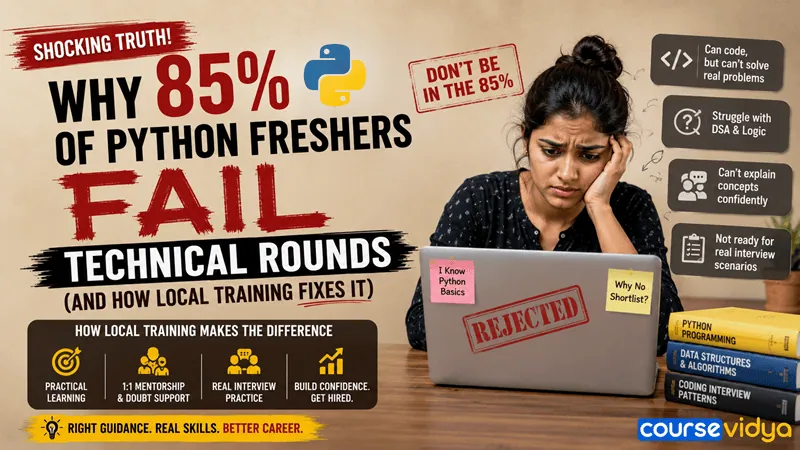
Failing a coding interview is often caused by a lack of preparation. However, failing a Python technical round is usually the result of preparing the wrong way. Around 85% candidates take online courses, read books, watch tutorials, and build a false sense of competence.
Taking online Python courses and tutorials
Most Python beginners start with online courses and tutorials. It teaches you the basic concepts and syntax, but ignores development logic. As a result, Python beginners often struggle to apply their learning to solve real problems, such as counting frequencies or solving pattern-based problems.
The online video courses and tutorials teach you what to write, but they rarely teach you when to use it and why. This creates a significant gap in their Python learning journey.
Ignoring Python fundamentals
Another common mistake in Python interview prep is to avoid the core fundamentals of Python. Concepts such as Pythonic paradigms, memory management, data structures, and time complexity are often asked in interviews to evaluate your grasp of core fundamentals.
Lack of communication during the interview
A Python technical interview is not only about coding, but it is also about communication. When freshers are presented with a coding problem during the technical rounds, they start solving it in silence. Interviewers don’t have a clue if you are thinking or confused about the problem they presented.
Experienced Python developers make a point of vocalizing their thought process, especially in the technical rounds. They explain their chosen approach and narrate their code as they write it. Interviewers are often willing to help the candidates if their initial code has some issues.
The gap in practical coding and problem-solving ability
A major gap in Python technical interview preparation is the lack of problem-solving and practical coding ability of freshers. Freshers often have theoretical knowledge they struggle to turn into working code that solves a problem.
Without exposure to classroom training, Python freshers are often unable to break down a problem logically. This is a critical factor in Python developers’ job preparation, where the majority of freshers fail.
Lack of understanding of Python interview questions for freshers
Fresher Python candidates waste days learning about Python’s history while ignoring the algorithmic patterns that modern tech interviewers ask about. Topics that dominate Python interviews are:
- Sliding window techniques
- String and array reversals
- Two-pointer approaches for array manipulation
- Basic reversals and matrix traversals
Tried and tested Interview tips for Python freshers
As a Python fresher, you first need to understand the hiring process, as interviewers aim to evaluate your day-one readiness. A standard Python technical round has three distinct phases. Interviewers generally start with basic screening questions, then move to coding challenges, and end with real-world coding questions.
You must focus on a few core areas to crack the Python technical round.
- Algorithm/logic challenges: You must prepare to handle basic data structures, such as array sorting, string manipulation, and more.
- Databases and API basics: The interviewer can ask you to explain how to fetch and parse JSON data or write a basic SQL query.
- Python-specific concepts: You must learn advanced topics such as the Global Interpreter Lock (GIL), decorators, and generators.
Why do online video courses fall short in Python job preparation?
Online learning gives you the illusion of progress, where you don’t have access to human feedback. Online learning platforms offer resources that are very helpful for learning the basics, but don’t guide your problem-solving approach or coding style.
Without a structured learning approach, Python freshers often take up too many resources. They read random Google articles, watch random YouTube videos, and skim complex concepts without even understanding the fundamentals. This approach leads to failure in the Python technical rounds, when interviewers start asking hard questions.
Why does local training help you crack the Python technical round?
Local Python training programs offer mentor-led classes, where you can interact with your teachers about your confusion and complex concepts you struggle with. It directly addresses the problems of isolated online courses with a human-centric development.
Advantages of local Python training for fresher interview prep
- Local training classes generally have a curriculum designed to meet the requirements of the modern tech industry.
- Students work on real-world coding challenges daily under the instructor’s guidance, which builds their problem-solving skills.
- Local classes often include mock interview prep simulating the actual interview scenarios with coding challenges while answering questions. It helps you prepare for the Python technical interview and acquire practical skills.
- Local training courses have experienced professionals who can point out your architectural mistakes, sloppy loops, and unoptimized logic. They help you build clean coding habits, which are essential for preparing for fresher coding interviews.
- Local training institutes often have direct ties with regional companies, and they can tailor your interview preparation according to the requirements of the local employers.
How to prepare for a Python technical interview?
Apart from joining a local Python training class, freshers need to be disciplined and consistent in their efforts to get hired by the tech companies. Python freshers need to make a habit of daily coding for at least an hour or two. The aim is to build logic, not memorize concepts and syntax.
You must solve previous Python interview questions for freshers. It will help you understand the common patterns in technical rounds and enhance your problem-solving speed.
You should attend mock interviews at the local training institute, as they will help you overcome your nervousness and improve your communication. The instructors help explain how communication works in the Python interview process, especially during the technical rounds. By practicing it in class, you will get used to describing your code when you are actually writing it.
Cracking a Python job interview is about having the knowledge and learning how to execute it under pressure. The local training institute exactly simulates that environment for you so you can actually perform well in the actual interview.
Conclusion
The lack of an appropriate preparation strategy is often the reason behind failing to pass the Python technical interview. Watching tutorials and completing online courses provides only a theoretical understanding. The gap between knowing the concepts and actually applying them is what leads to repeated failure for Python freshers in technical rounds.
You need to start treating coding as a performance skill, investing time in problem-solving practice, code reviews, and mock interviews. Seek out a mentor-led training program in your area and give your Python interview preparation a practical edge.