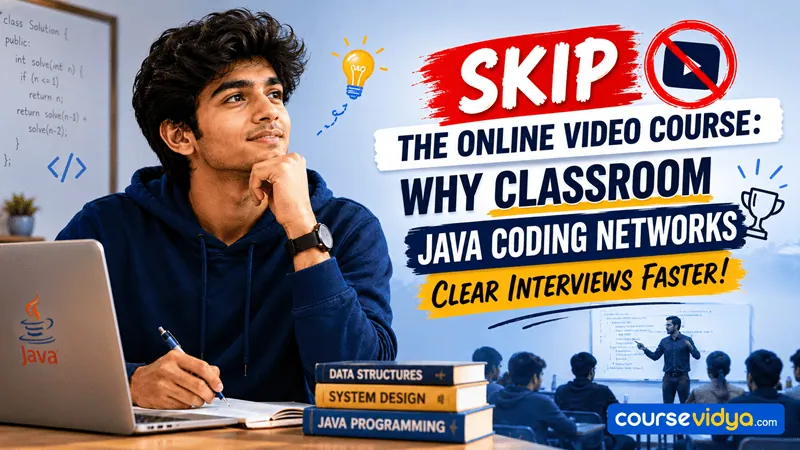
Interested in pursuing the Java career path as a fresher, but confused between classroom training and an online course?
In recent years, online learning has been on the rise with hundreds of self-paced platforms, YouTube tutorials, and video courses. Learning Java has become much easier, as you can start today from home. You only need an internet connection and a laptop.
But if you want to know how to become a Java developer, are the online courses as effective as Java classroom training?
The answer is no.
Entry-level Java aspirants who go through rigorous classroom training do comparatively better in Java interviews than those who learn through online courses. Despite the advantage of easy accessibility and low cost, online Java courses lack practical application. Learners watch videos without interacting with instructors or applying their learning in practical projects.
Read this blog to discover the best Java learning path and why Java classroom training is better than online courses!
How to get a Java job as a fresher: why classroom courses work
Java interviews generally take a practical approach. Interviewers focus on evaluating your hands-on experience and ability to solve real-world problems. This is where Java video learners struggle. They are often unable to apply their knowledge to practical situations.
On the other hand, Java classroom learners are more apt at practical projects. A structured Java developer roadmap requires live training and the opportunity to work on real projects. It gives them greater knowledge and confidence when tackling difficult real-world Java applications and interviews.
Moreover, most Java classroom training programs arrange mock interviews for students. The opportunity to work on real projects and build portfolios offers classroom Java learners a significant advantage in getting an entry-level Java developer job faster.
Java classroom training vs online course: which one delivers the real value
Java classroom training programs are instructor-led sessions with a strict curriculum. On the other hand, online courses are video-based, pre-recorded classes with little or no real interaction between the instructor and learners.
| Elements | Java classroom course | Java online courses |
|---|---|---|
| Learning environment | Structured learning with instructors. | Pre-recorded video classes for self-paced studying. |
| Frequency of mentor feedback | Instant. | Limited or no feedback. |
| Accessibility | Require physical presence in the classroom. | Remote learning style with high accessibility. |
| Accountability | High accountability, as classroom Java courses have a fixed curriculum and require physical attendance. | Low due to its self-paced nature. Learners can easily skip chapters or abandon the whole course. |
| Practical skill | Working on real projects. | Standardized projects with low value. |
| Interview preparation | Structured mock interviews. | No mock interviews. You can read probable interview questions. |
| Networking and Jobs | Built-in recruiters’ network and hiring drives. | Limited support or no career support. |
| Affordability | Requires a significant financial investment. | Low-cost programs. |
Why learners look for Java online courses
Java online courses are often pre-recorded videos. You can proceed through the courses at your own pace. You can pause, rewind, and revise at any time. Many beginners ask, “how to start learning Java?” but are unsure about investing a significant amount in classroom courses and often opt for online Java programs.
Online Java courses are affordable and provide certifications. These two are the key factors for Java beginners, as they help them earn a Java credential without spending much. Online Java courses are also popular among career switchers who want to get a Java job as a fresher without attending in-person classes.
Classroom AI training vs self-learning AI: your guide on how to get an AI job
How classroom Java training connects you to tech recruiters
The Java classroom coding network represents a structured learning environment with a live instructor. With a fixed curriculum, students learn through collaborative coding activities and continuous instructor feedback. Interacting with a peer group also enriches the learning experience in the Java classroom, as you gain different perspectives on problem-solving. It also encourages teamwork among entry-level Java learners.
One key advantage of an in-person classroom Java training is the focus on structured, consistent learning. In an instructor-led training, students are assigned multiple programming challenges, which help them build practical skills from the ground up.
Based on learners’ performances, instructors provide individualized guidance. It helps fresher Java aspirants identify their weaknesses and improve their performance in actual interviews. Also, classroom Java courses offer hiring drives, as they have an established network of tech recruiters. This helps you get the first Java job after you complete the course.
Overall, the Java classroom coding network makes a noticeable difference in your practical skills, offering career support and personalized feedback. These are the reasons why you should always choose Java classroom courses over an online program, considering you have the required resources and time.
Why a classroom course helps you to crack Java interviews faster than online courses
New learners often wonder, “how long does it take to learn Java?”. However, clearing Java interviews requires more than just understanding the fundamentals and the basic concepts. In Java interviews, candidates are asked to perform under pressure and solve real-world issues. Java classroom courses help learners to develop these skills in a structured learning environment.
Instant doubt solving
In Java classroom courses, you will have access to a mentor. Whenever you are working on any projects, you get immediate feedback. If you get stuck on a coding exercise or are confused about a complex concept, you can instantly ask for help.
Instant access to a mentor significantly reduces the risk of developing bad coding habits, such as writing monolithic functions. In Java classroom courses, mentors can intervene before confusion. A lack of understanding can negatively affect your chances of getting a fresher Java developer job.
Fixed and structured curriculum
One of the main differences between a Java classroom training and an online course is the structured curriculum. A complete fresher Java developer roadmap is provided in classroom courses with a structured syllabus. The classes are designed to cover the core concepts of Java fundamentals, data structures, and related topics in a step-by-step manner.
Because the Java classroom curriculum is often structured in a logical sequence, learners can focus on skills that employers actually want.
Healthy competition and motivation
Peer interaction is another reason why Java classroom training is better than online courses. When you are learning among peers, healthy competition is common. Learners often get motivated to be more consistent and improve by seeing their classmates succeed. Healthy competition is a key motivator in Java classroom courses.
Accountability
Accountability is another factor that favors classroom training to crack a fresher Java job interview faster. In classroom Java courses, students attend classes regularly and complete assignments. It helps eliminate procrastination, a common issue among online learners.
Mock interviews
Entry-level Java interview preparation is generally a part of classroom courses. In mock interviews, mentors help Java learners become comfortable performing coding tasks. This way, Java learners can identify and improve weak areas before they face actual interviews.
Conclusion
With the continuous demand for Java developers, the options for both online and offline Java courses are endless. If you search online, you will probably find a vast number of physical institutes and online platforms offering Java certification programs. It’s easy to get confused while choosing between so many options.
If you are trying to figure out how to become a Java developer, go for classroom courses that offer industry-recognized certifications and career support. Java classroom courses are unmatched for their effectiveness in preparing for Java interviews.
But if you are only looking to update your Java learning, you can opt for online Java courses on reputable platforms. It’s affordable and helps you study at your own pace.
But if you have the financial means and time, choose a classroom Java course to optimize your learning and improve your chances of getting hired. To discover highly accredited Java training courses, both in-person and online, visit CourseVidya.com. It is a unified platform for searching, comparing, and selecting an appropriate course aligned to your needs. Visit CourseVidya.com, India’s own course search engine.