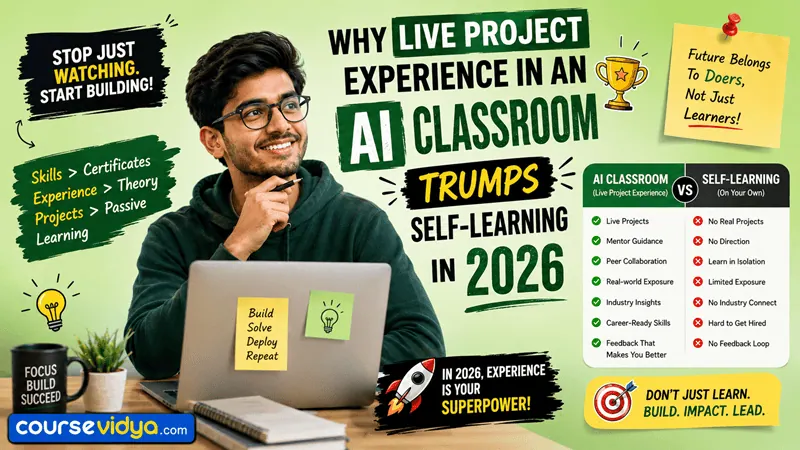
In recent years, learning Artificial Intelligence has become fundamental as reading literacy and basic computer knowledge. AI professionals who integrate AI earn a premium wage. With rapid growth, the AI industry has become one of the most attractive fields for aspiring professionals.
If you are wondering how to start a career in artificial intelligence, the internet is filled with thousands of tutorials, free AI courses, AI assistants, and open-source tools to help you learn AI. It can often feel like you can master AI without even leaving your room. With easy internet access and free resources, many AI learners start with self-learning, driven by low cost and flexibility.
But as you move forward with your learning, you will face a common challenge that self-learners often face: information overload with no real direction. That is exactly why you need classroom AI training paired with live projects to navigate modern artificial intelligence career paths successfully.
That is exactly why you need classroom AI training with live projects.
The demand for job-ready AI professionals has shifted more toward real-world application and project-driven experience, whereas self-learning from online AI courses only teaches you concepts. This blog explores why classroom training with live projects is essential in learning AI and gets you job-ready rather than self-study.
The rise of the self-learning AI culture to become AI job-ready
In the last few years, we have all witnessed a sudden surge in AI self-learning along with the unprecedented popularity of YouTube tutorials, online platforms with free AI courses, and open-source communities for AI enthusiasts. It has made it easier for anyone with internet connectivity to dive into Python, Machine Learning, Natural Language Processing, and more.
Additionally, the easy access to AI tools like ChatGPT, Gemini, and open-source models has enabled AI learners with no prior coding experience to experiment with various tools. This is why so many people are taking up self-learning AI courses, seeing the unlimited resources available online, and using AI assistants to simplify complex concepts. The ‘self-taught AI’ model is highly appealing among beginners interested in artificial intelligence career paths.
However, the self-learning approach is isolated and lacks proper structure. The availability of a vast number of tutorials, free courses, and online resources can make it difficult for you to identify what is essential and what is not. Without a proper structure, learning AI can easily become messy, leaving gaps in knowledge.
What does AI classroom learning with live projects actually mean in the AI job market?
Nowadays, an Artificial Intelligence classroom training with live projects is not similar to a traditional lecture-based course. It allows learners to gain hands-on experience building a real-world AI solution under a mentor’s guidance. These classrooms foster peer collaboration and enable students to work on industry-relevant problems.
Classroom projects are also diverse. You may learn to develop chatbots, computer vision applications, predictive models, or recommendation systems. The key difference between self-learning and classroom training is that classroom AI courses allow you to practice the theories and concepts you read. You will learn to write code, along with how to design, test, and modify a system in a classroom AI course.
Mentorship and peer collaboration are two important factors in learning and finally getting a job in AI. In the classroom, you receive expert mentor feedback at every stage and learn from your mistakes safely. The combination of this structured approach, continuous feedback, and real-world projects is the best way to learn Artificial Intelligence, as it ensures you grow demonstrable AI skills.
Self-taught vs classroom learning – how to get a job in AI
The core difference between classroom AI training and self-learning comes down to which one allows you to gain better employability skills. To properly learn AI through self-studying, you need strict discipline and consistency. If you don’t have a goal and no instructor to guide you, you will go through various video courses and tutorials without retaining anything.
Conversely, AI classrooms have a well-defined curriculum with guided milestones that provide direction for AI learners. The presence of an instructor injects immediate feedback and guidance into your routine, helping you resolve any problems you encounter.
| Metrics | Self-learning AI | Classroom AI training |
|---|---|---|
| Speed of learning | Low as you can run into debugging issues and complex concepts. | High with the help of an expert instructor. |
| Depth of understanding | Surface-level and concept-driven. | In-depth understanding with code reviews. |
| Project readiness | Low as projects are often similar to standard GitHub templates. | Highly, as learners are guided to build an industry-grade deployable architecture. |
| Industry Exposure | Very limited to forums and personal network. | Directly with guidance of expert instructors, peer collaboration, and real-world problem solving. |
How to start a career in Artificial Intelligence with classroom training and live projects
Live Artificial Intelligence learning projects offer an opportunity to apply your learnings to build practical. Hands-on projects help simulate real-world problems, allowing students to face the challenges AI professionals face.
Framing complex problems
In classroom AI training, you will be able to develop critical skills that are difficult to acquire when you are studying alone. You learn to clean and manage real datasets, frame complex problems, refine machine learning models, and deploy solutions using cloud platforms or APIs. These steps mirror the responsibility of an AI engineer in the AI industry.
Real-world constraints
When you work on live projects, you will run into tight deadlines, messy data, and challenges of working in a collaborative environment, such as coordination and communication. In the classroom, you gradually build these cognitive skills, which allow you to be more efficient and adaptable, which are highly valued by employers.
Portfolio building
When you are taking a classroom AI training, one of the biggest advantages is that live projects are now part of your portfolio. You can display your portfolio to recruiters as proof of your ability to work with AI models. In recent years, hiring managers have prioritized demonstrable AI skills over AI certificates. Additionally, building fully functioning systems can help you grow in confidence and achieve a sense of accomplishment.
45-Day AI career plan: A practical guide to get your first AI job
Limitations of self-taught professionals to get into the AI job market
- The Artificial Intelligence industry is rapidly growing with new models, tools, and frameworks emerging every other day. This makes it difficult for the AI self-learners to decide what to focus on.
- A self-learner often thinks that learning from multiple sources results in more knowledge. However, it leads to surface-level understanding and a lack of ability to apply the concepts.
- Without a feedback system, self-learners often repeat the same mistakes.
- Self-learning doesn’t equip you with industry-standard skills such as code reviews, collaboration, and debugging.
Why is hybrid AI learning becoming popular among professionals?
Both self-learning and classroom learning have different advantages in AI training. A hybrid method can be the most effective for beginners looking to build their career in AI. It allows them to take classroom AI training while continuing self-learning at home.
Self-learning enables experimentation and exploration, helping learners stay up to date in the continuously evolving AI industry. On the other hand, an AI classroom provides an execution-focused environment where you can apply your knowledge to build AI tools.
When you combine both methods, you enter a cycle of continuous improvement in which your classroom AI projects enrich your theoretical knowledge. If you balance self-learning with classroom live projects, you will grow and adapt to the evolving AI world. As a result, you will secure a high-paying AI job faster.
Conclusion
As the AI industry has transformed gradually from niche academic research to generative AI, understanding how to start a career in artificial intelligence requires a shift in mindset. Today, learning AI is not just about gathering information but about execution and application.
When exploring various Artificial Intelligence career options and sources for learning it, live project-based classroom programs have clear advantages. They prepare you to tackle the challenges AI engineers face frequently. While the self-study learning model is highly effective for learning basic concepts and a few AI tools, it often falls short of providing the hands-on experience needed to stand out in the AI job market.
Classroom AI training with live projects provides you with a complete AI learning environment that equips you with industry-focused problem-solving skills. If you are researching artificial intelligence career paths for beginners and trying to figure out how to get an AI job, combining theoretical knowledge with live project execution is the most reliable strategy. Balancing both models will give you the demonstrable skills required to navigate the competitive market and secure a rewarding role faster.